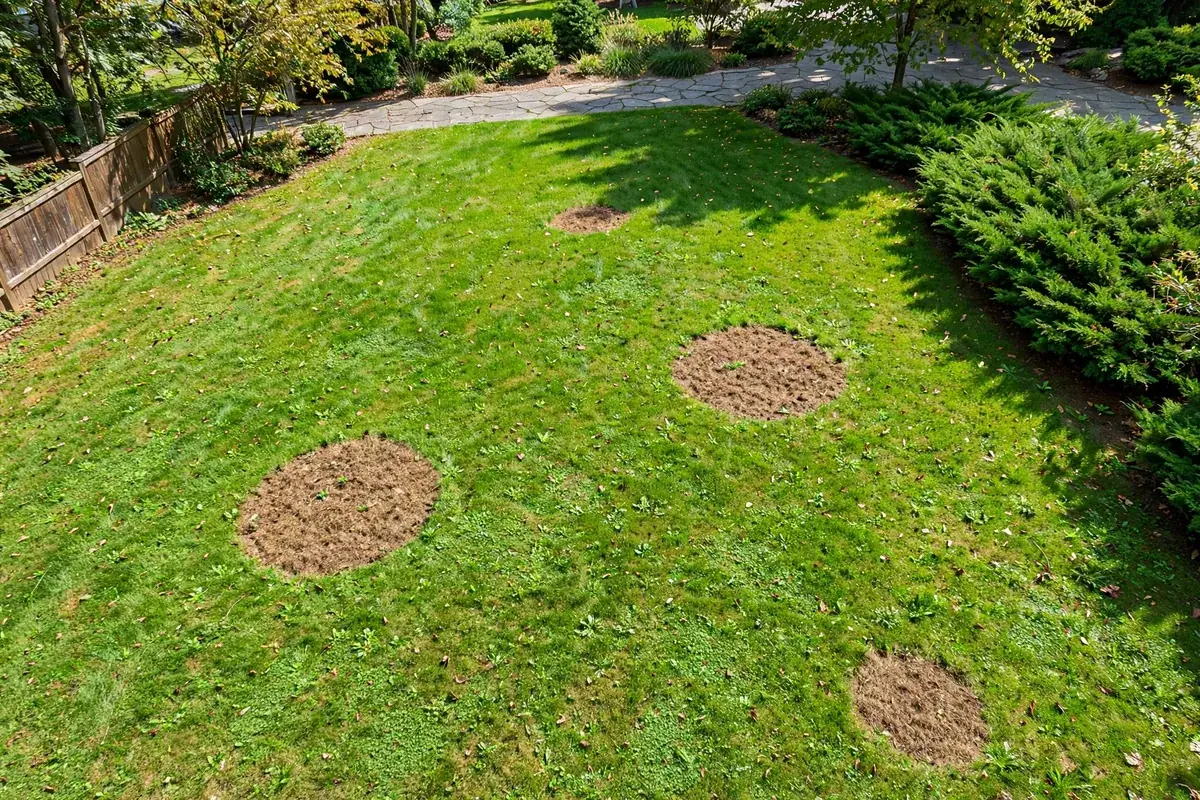
Brown Spots in Your Lawn? Identify the Cause by Shape
There’s a brown patch in your lawn staring back at you every time you pull into the driveway. But “brown spot” isn’t a diagnosis — it’s a symptom with half a dozen completely different causes, and treating the wrong one wastes a season.
The shortcut professionals use: read the shape like a map. Perfect circles mean one thing. Irregular patches that peel up like carpet mean another. Browning along the driveway edge means something else entirely. Match your patch to the six shapes below and you’ll know the cause in two minutes — each with a 30-second confirm test.
Identify by Shape — The Visual ID Guide
Walk out to the patch and look at its outline before you do anything else. Match it to one of these six:
Perfect Circles → Fungal Disease
If the brown area forms expanding circles or rings — especially with a darker “smoke ring” edge after warm, humid weather — you’re looking at lawn fungus:
- Brown patch disease — large circles, often a foot or more across, dark ring at the advancing edge. Thrives in heat and humidity.
- Dollar spot — smaller circles, roughly silver-dollar sized, sometimes with a bleached-white center.
Fungal spots stay firmly rooted — dead or dying, but they don’t lift. They expand outward over days in the right weather: a circle that was 6 inches Monday and 10 inches Friday is alive and spreading.
This article is the triage, not the treatment manual: for full identification and treatment of these diseases, see our deep-dives on brown patch lawn disease and dollar spot lawn disease. For treatment options across fungal problems, see our lawn fungus treatments guide.
For smaller silver-dollar-sized spots with bleached centers, see MSU Extension’s dollar spot guide.
If your circles are large with a dark ring at the advancing edge, compare them with MSU Extension on brown patch symptoms.
Irregular Patches That Lift Like Carpet → Grubs
If the brown patch is irregularly shaped (no clean circle, no straight lines) and the turf feels spongy underfoot, suspect grubs — the white larvae of beetles feeding on grass roots underground, usually peaking in late summer.
The tug test (30 seconds, definitive): grab a handful of grass at the edge of the brown patch and pull upward. Grub-damaged turf lifts like loose carpet — the roots are chewed off, so the whole section peels back easily, and you’ll see the white C-shaped grubs in the soil underneath. Fungal patches, by contrast, stay firmly rooted when you pull. Carpet-lift = grubs. No lift + circles = fungus. That distinction settles the two most confused causes in half a minute.
Brown Along Edges, Near Pavement, or on High Spots → Heat/Drought Stress
If the browning follows edges — along the driveway, sidewalk, or curb — or sits on the high spots of the lawn while low areas stay green, that’s heat and drought stress. Pavement radiates heat and sheds water away from the adjacent strip; high spots drain fastest and dry first. The pattern matches sun and water exposure, not a pest.
The footprint test: walk across the brown area in the morning. If your footprints stay visible — the grass blades stay pressed down instead of springing back — the turf is wilted from lack of water. That’s drought stress, and the fix is water, not chemicals.
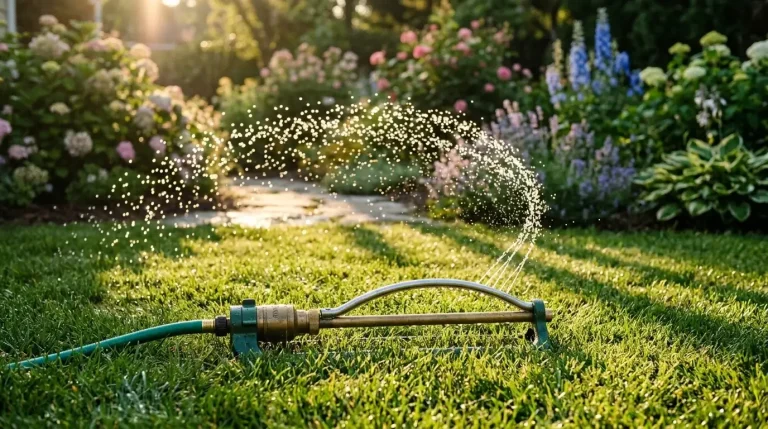
The fix: water deeply and less often to train deep roots, and check your sprinkler coverage on those edge strips and high spots — they’re the first places a system under-waters. See how often to water your lawn for the full watering schedule.
Small Round Spots With Dark-Green Rings → Dog Urine
If you see small round brown spots (a few inches across) each surrounded by a ring of extra-dark-green grass, that’s dog urine. Concentrated nitrogen in urine burns the center dead while the diluted edges act as fertilizer — hence the telltale green halo. Multiple spots along a fence line or favorite patrol route confirm it.
The fix: if you catch it happening, flood the spot with water immediately — dilution is the only thing that works in the moment. Long-term, train the dog to a single mulched area, or keep a watering can by the door. Dead centers won’t recover; they’ll need reseeding (see Repair below).
Streaks or Patches After Fertilizing → Fertilizer Burn
If the brown areas form straight lines or stripes — matching your spreader passes — or appear as heavy spots where you stopped, turned, or overlapped, that’s fertilizer burn. Too much nitrogen in one place desiccates the grass (salt burn). It shows up within days of fertilizing, which is the timing clue.
The fix: water deeply to flush excess salts down past the root zone — the sooner the better. Light cases recover; severe burn kills the crowns and needs reseeding. Prevention: calibrate your spreader, keep a steady walking pace, and never stop with the spreader open.
Brown Under Trees or in Shade → Shade + Competition
If the brown, thinning area sits under a tree canopy or in deep shade, the cause is light starvation plus root competition — tree roots outcompete grass for water and nutrients, and the grass can’t photosynthesize enough to stay dense.
The fix here is different from every other shape on this list, because you can’t fix a light problem with water or fertilizer: prune lower tree limbs to let more light through (often the single biggest improvement), switch to shade-tolerant grass seed when reseeding, or accept mulch — in deep shade where grass keeps failing, a mulched bed beats a permanent brown patch.
The Shape-ID Quick Table
For skimmers — the whole guide in one table:
| Shape you see | Likely cause | Confirm with | Fix |
|---|---|---|---|
| Perfect expanding circles | Fungal disease | Watch it grow over days; humid weather timing | Disease deep-dives + fungus treatments |
| Irregular patches, spongy | Grubs | Tug test — lifts like carpet, white grubs in soil | Grub treatment, reseed |
| Brown along pavement edges / high spots | Heat/drought stress | Footprint test — prints stay visible | Deep watering, fix sprinkler coverage |
| Small rounds with dark-green rings | Dog urine | Green halo; along patrol routes | Flood with water; reseed dead centers |
| Straight streaks after fertilizing | Fertilizer burn | Stripes match spreader passes; days after feeding | Water deeply to flush salts |
| Thin brown under trees/shade | Shade + root competition | Location under canopy | Prune limbs; shade seed; or mulch the bed |
Brown vs. Yellow — Which Guide Do You Need?
Quick router, because these get confused:
- Grass is yellow but still alive — yellowing blades, thinning color, but the turf is intact and growing? That’s a different diagnosis (nutrient deficiency, early stress, dull mower blade, early-stage issues). See our companion guide: why is grass turning yellow in patches — it covers yellowing-but-alive grass with symptom tables and hands-on tests.
- Grass is brown and DEAD — crispy, no green at the base, patches matching the shapes above? You’re in the right place.
They’re companion guides, not competitors: yellow-but-alive goes one way, brown-and-dead goes the other. Not sure which you have? Check the blade bases — green at the crown means alive (yellow guide); brown all the way down means dead (this guide).
Repair the Dead Spots
Brown-and-dead grass won’t come back — dead is dead. (Brown-but-alive stressed grass from drought usually greens up within days of proper watering; that’s the distinction that matters.) For the truly dead patches:
- Rake out the dead turf down to bare soil. Dead grass left in place blocks seed-to-soil contact.
- Topdress lightly with compost or quality topsoil to level the spot.
- Reseed in fall — warm soil, cool air, low weed pressure. Keep the seed consistently moist until established. Our guide to overseeding a lawn without aerating covers the full process.
One warning: bare spots invite weeds. Crabgrass seed is always waiting for sunlight on bare soil — a dead patch left unrepaired through spring becomes a crabgrass patch by summer. Reseed promptly, and if crabgrass does move in, see how to get rid of crabgrass without killing grass.
Frequently Asked Questions
What causes brown spots in my lawn?
The shape tells you: circular patches mean fungal disease, irregular patches that pull up easily mean grubs, browning along edges or high spots means heat/drought stress, small spots with dark-green rings mean dog urine, and streaks appearing after fertilizing mean fertilizer burn. Match your patch’s shape to the guide above, confirm with the test, then treat the actual cause.
How can I tell if brown spots are grubs or fungus?
The tug test: grab the grass at the patch edge and pull upward. Grub-damaged turf lifts like loose carpet — the roots are chewed through, and you’ll see white grubs in the soil. Fungal patches stay firmly rooted but form expanding circles, usually during humid weather. Carpet-lift = grubs; rooted + circles = fungus.
Will brown dead spots in my lawn come back?
Dead grass — brown all the way down with no green at the crown — won’t recover. Rake it out and reseed. But brown-but-alive stressed grass (drought, heat) usually greens up within days of proper deep watering. Check the crown: green at the base means alive; brown throughout means it’s gone.
What’s the difference between brown patch disease and brown spots?
“Brown patch” is one specific fungal disease (Rhizoctonia) that causes large circular spots with a dark ring. “Brown spots” is the general symptom with many possible causes — fungus is only one of them. If your circles match the brown patch description, our brown patch lawn disease guide covers that disease in full.
Can dog urine cause brown spots in grass?
Yes. Concentrated nitrogen in urine burns a round spot dead in the center, while the diluted edges fertilize the surrounding grass extra green — creating the telltale dark-green ring. If you catch it happening, flood the spot with water immediately to dilute it. Dead centers need reseeding.
Should I water brown spots more?
Only if drought or heat stress is the cause — confirm with the footprint test (footprints stay visible = wilted = needs water). Overwatering makes fungal brown spots worse, so identify the cause by shape first, then water accordingly. Watering the wrong brown spot is how a small fungus problem becomes a big one.