Dethatching: What It Is and How to Do It Right
Dethatching: What It Is and How to Do It Right
Dethatching is the process of removing the thick layer of dead grass stems, roots, and debris — called thatch — that builds up between your soil and your green grass blades. When thatch grows thicker than half an inch, it blocks water, air, and fertilizer from reaching the roots, leaving your lawn spongy, patchy, and dull no matter how much you water or feed it.
You dethatch with a special dethatching rake, a power rake, or a vertical mower that digs into the thatch layer and pulls it to the surface. The best time is early fall or mid-spring for cool-season grasses (Kentucky bluegrass, fescues, ryegrass) and late spring to early summer for warm-season grasses (bermuda, zoysia, St. Augustine) — always while the grass is actively growing so it bounces back fast. Afterward, rake up the debris, water deeply, and overseed any thin spots.
What Is Dethatching?
Dethatching means physically tearing out the thatch layer — the tightly packed mat of dead and living stems, roots, and organic debris sitting right on top of your soil, underneath the green blades. A dethatching tool cuts through the grass canopy into that mat, loosens it, and drags it to the surface for raking and removal.
This is not leaf raking — that clears surface litter, while dethatching goes below the visible grass into the mat itself, which is why you need a purpose-built tool. And it’s not aeration either: aeration pulls soil plugs to relieve compaction, while dethatching removes organic matter sitting on top of the soil.
What Is Thatch, Exactly?
Thatch is a normal byproduct of a growing lawn. As grass grows, older stems and roots die and slough off faster than soil microbes can decompose them. Heavy nitrogen fertilization, frequent shallow watering, compacted soil, and pesticide use that suppresses soil life all tip the balance toward buildup.
Some grasses are simply thatch factories. Creeping types with aggressive rhizomes and stolons — Kentucky bluegrass, bermudagrass, zoysiagrass, and bentgrass — produce thick thatch and may need dethatching every year or two. Bunch-type grasses like tall fescue and perennial ryegrass produce far less thatch and often go years without needing it, according to University of California turf specialists.
A thin layer of thatch (under half an inch) is actually beneficial — it cushions the turf against foot traffic, insulates the soil, and reduces water evaporation. The trouble starts when the layer keeps growing.
How Much Thatch Is Too Much?
The rule every turf extension program agrees on: once thatch exceeds half an inch, it’s time to act. Past that point it starts sealing off the soil surface. At over an inch thick, it’s a serious problem — water sheets off instead of soaking in, fertilizer granules get trapped in the mat instead of reaching roots, and grass roots start growing up into the thatch instead of down into the soil, making the lawn drought-prone and fragile.
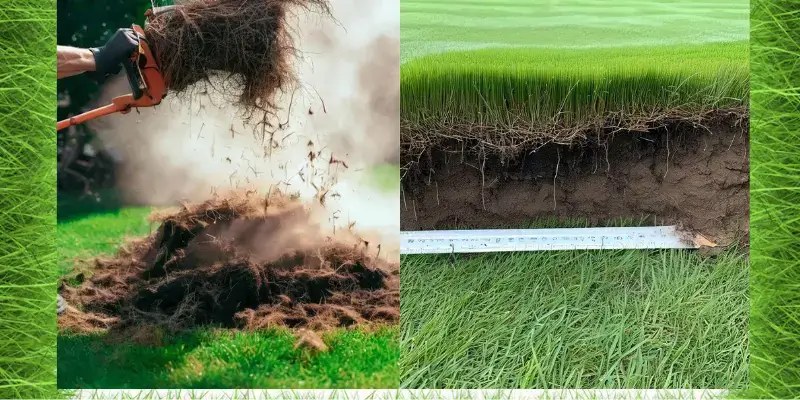
Check yours with the plug test:
- Push a shovel or hand trowel into the lawn and cut a small wedge about 3 inches deep.
- Lift it like a flap and look at the side profile.
- Find the brown, spongy, felt-like layer sitting between the green growth and the dark soil — that’s thatch.
- Pinch it and measure. Under ½ inch: you’re fine. ½ to 1 inch: plan a dethatching, especially with symptoms. Over 1 inch: dethatch — and consider spreading an aggressive case over two or three seasons.
Also trust your feet. If the lawn feels spongy or bouncy underfoot, like walking on a thin mattress, that’s the thatch mat compressing — a classic sign it’s too thick.
Why Dethatching Matters
A thick thatch layer hurts your lawn in several compounding ways:
- It blocks water. Rain and irrigation sit in the spongy mat or run off instead of reaching the root zone. You water more; the roots get less.
- It starves the roots. Fertilizer lodges in the thatch and breaks down there instead of reaching the soil.
- It suffocates the soil. Air can’t move through a dense mat, slowing the microbes that would decompose the thatch — a vicious cycle.
- It harbors pests and disease. The damp mat is ideal habitat for fungal pathogens and thatch-dwelling insects.
- It makes roots lazy. Roots grow up into the water-holding mat instead of deep into soil, leaving the lawn fragile in heat or drought.
Dethatching resets all of this in a single session: water penetrates again, fertilizer reaches the soil, air moves, and roots drive downward.
7 Signs Your Lawn Needs Dethatching
- It feels spongy underfoot. The bounce test never lies — a springy, mattress-like feel means a thick mat.
- Water pools or runs off. If puddles linger after rain or irrigation water sheets off a slope, the thatch is sealing the surface.
- Fertilizer doesn’t seem to work. You feed on schedule but the lawn stays pale and hungry-looking — nutrients are trapped in the mat.
- It’s dull and patchy despite watering. Adequate water plus poor color equals a delivery problem, not a supply problem.
- The plug test shows over ½ inch. The definitive check (see above).
- Disease or pests keep recurring. Fungal patches and insect damage that return every season often trace back to thatch habitat.
- Your mower rides high or scalps. A thick mat lifts the mower deck, so blades cut unevenly and scalp the high spots.
If you check two or three of these boxes, dethatch this season. If you only check one, retest in a few months — there’s no prize for dethatching a lawn that doesn’t need it.
When to Dethatch Your Lawn
Golden rule: dethatch only when the grass is actively growing and can recover quickly. Dethatching is controlled injury — you want the lawn at its most vigorous so it fills back in within weeks.
- Cool-season grasses (Kentucky bluegrass, fescues, perennial ryegrass): early fall is ideal — roughly late August through October, when growth is strong, heat stress is past, and few weed seeds are germinating. Early to mid-spring is the second choice.
- Warm-season grasses (bermuda, zoysia, St. Augustine): late spring through early summer, once the lawn is fully greened up and growing hard. Oklahoma State’s turf specialists put the sweet spot at February–March before green-up for warm-season lawns in southern climates, and late September through mid-October for cool-season lawns.
Avoid dethatching during summer heat or drought, when the lawn is dormant, or when weeds are actively germinating — you’ll open the canopy just as crabgrass moves in. And if you’re planning preemergence herbicide, apply it *after* dethatching, since the chemicals can bind to thatch instead of reaching the soil.
Timing is only half the equation — see our detailed breakdown of how often you should dethatch different grass types.
Dethatching Methods Compared
| Method | Best for | Effort | Notes |
|---|---|---|---|
| Dethatching rake | Small lawns, light thatch | High manual effort | Cheap; the only realistic hand option |
| Power rake | Medium–large lawns, moderate thatch | Medium (machine does the work) | Rentable; flailing tines tear thatch loose |
| Vertical mower (verticutter) | Large lawns, thick thatch | Medium–high | Most aggressive; slicing blades, adjustable depth |
Manual Dethatching Rake
A dethatching rake looks like a regular rake crossed with a saw — stiff, knife-like tines designed to dig into the turf and drag thatch up. It’s the right tool for small lawns or spot-treating problem areas, and it costs little. The tradeoff is sweat: it’s genuinely hard work on anything bigger than a few hundred square feet. A standard leaf rake or garden rake won’t cut it — the tines are too flexible to bite into the mat.
Power Rake
A power rake (often called a dethatcher at rental shops) uses rotating flailing or spring tines to comb through the turf and fling thatch to the surface. It’s the sweet spot for most homeowners: far faster than hand raking, less brutal than a vertical mower, and widely available as a day rental.
One warning from the University of Minnesota: skip the “dethatching blade” attachments sold for rotary mowers. Their testing found these add-ons ineffective at actually removing thatch — and quite destructive to healthy grass. Rent the real machine instead.
Vertical Mower (Verticutter)
A vertical mower has a reel of fixed vertical blades that slice through the thatch into the top of the soil — typically about an inch deep and an inch apart for creeping grasses. It’s the most aggressive option and the right call for thatch over an inch thick. Because it cuts rather than tears, results are cleaner — but the lawn will look rougher and need longer to recover. For extreme thatch, UC and Oklahoma State advise splitting the job across two or three seasons rather than scalping it all at once.
How to Dethatch Your Lawn: Step by Step
- Confirm you need it. Do the plug test first. Dethatching a healthy lawn is all pain, no gain.
- Mow short. Cut about half an inch shorter than your normal cutting height so the dethatching blades can reach the thatch layer instead of fighting through tall grass.
- Water lightly the day before. Slightly moist soil is ideal — the tines penetrate cleanly. Soggy soil tears; bone-dry soil resists. Never dethatch mud.
- Mark obstacles. Flag sprinkler heads, shallow utility lines, and invisible fence wire. Power equipment will find them the hard way.
- Set a shallow depth. Start with the blades just kissing the thatch — you want to comb the mat, not excavate soil or rip out crowns. You can always go slightly deeper on the second pass.
- Make the first pass. Work in straight, slightly overlapping lines across the lawn in one direction, like mowing.
- Make a second pass at 90 degrees. The perpendicular pass — recommended by UC’s turf program — catches thatch the first pass missed and gives a far more even result.
- Rake up everything. You’ll be amazed at the volume — wheelbarrow-loads from a medium lawn. Don’t leave it sitting; a blanket of loose thatch smothers the grass you just freed. Compost it — it makes an excellent soil conditioner — or bag it for municipal pickup.
Dethatching Aftercare: What to Do Next
Your lawn will look rough — thin, a little ragged, possibly brown in patches. That’s normal. Give it two to four weeks of good care and it comes back thicker than before:
- Water deeply. Soak the lawn thoroughly right after dethatching, then return to deep, infrequent watering. Moisture is what powers recovery.
- Feed lightly. A light application of balanced fertilizer (about ½ to ¾ pound of actual nitrogen per 1,000 square feet, per Minnesota Extension) gives the grass the fuel to fill in.
- Overseed thin spots. Dethatching opens the perfect seedbed — seed-to-soil contact is excellent right now. This is the ideal moment to thicken a tired lawn.
- Stay off it. Keep foot traffic light for a couple of weeks while new growth knits in.
Don’t be alarmed if your lawn looks thin and tired for two to three weeks — here’s how to fix a lawn that looks bad after dethatching and speed up recovery.
Dethatching vs Aeration: What’s the Difference?
Homeowners mix these up constantly, so here’s the clean distinction:
| Dethatching | Core aeration | |
|---|---|---|
| Removes | Dead organic mat *on top of* the soil | Plugs of *soil itself* |
| Fixes | Thatch buildup blocking water/nutrients | Compacted soil suffocating roots |
| Tool | Dethatching rake, power rake, verticutter | Core aerator (hollow tines) |
| Lawn looks | Rough, thinned for 2–3 weeks | Dotted with soil plugs for a week |
| Best paired with | Overseeding | Topdressing |
Which do you need? Do two tests: the plug test (thatch over ½ inch → dethatch) and the screwdriver test (screwdriver won’t push into moist soil → aerate). Many neglected lawns need both — dethatch first, then aerate; the tines also help break down remaining thatch. If a screwdriver won’t push easily into your soil, compaction — not thatch — is your real problem, so learn when to aerate your lawn instead.
5 Common Dethatching Mistakes to Avoid
- Dethatching a dormant or stressed lawn. Mid-summer heat, drought, or winter dormancy plus dethatching equals a lawn that may not recover until next season. Wait for active growth.
- Setting the blades too deep. The goal is to comb the thatch, not till the soil. Too deep and you’ll rip out healthy crowns and roots along with the debris — the lawn thins instead of thickens.
- Working wet, soggy soil. Wet thatch tears in clumps, the machine ruts the lawn, and you’ll do more damage than the thatch ever did. Moist, not muddy.
- Skipping aftercare. Dethatching without watering, feeding, and overseeding is like surgery without rehab. The lawn stays thin and weeds move into the bare soil.
- Dethatching on a schedule instead of by need. “Every spring” is not a plan — it’s a habit. Some lawns need it yearly (bermuda, zoysia); others go five years (tall fescue). Test first, dethatch second.
Dethatching FAQs
How often should I dethatch my lawn?
It depends on your grass. Aggressive creepers (Kentucky bluegrass, bermuda, zoysia, bentgrass) can need it every one to two years; tall fescue and ryegrass often go three to five. Check thatch depth yearly with the plug test and dethatch only past half an inch — not on a calendar.
Can I dethatch with a regular leaf rake?
Not effectively. Leaf rake tines are too flexible to bite into the thatch mat — you’ll clear surface debris and think you dethatched, but the mat stays. Use a proper dethatching rake at minimum; rent a power rake for anything beyond a small lawn.
Will dethatching kill my grass?
No — but expect a thin, ragged lawn for two to three weeks. That’s normal stress, not damage, as long as you dethatched during active growth at the right depth. Lawns with proper aftercare come back denser than before.
Should I dethatch or aerate first?
Dethatch first, then aerate if the soil is also compacted. Dethatching clears the mat so the aerator’s tines reach soil cleanly, and the aeration holes help decompose remaining thatch. Reverse the order and you waste the aeration benefit under a thatch blanket.
Can I compost the thatch I remove?
Yes — it’s excellent compost feedstock. Thatch is carbon-rich organic matter; mixed with nitrogen-rich greens, it breaks down into a superb soil conditioner for garden beds.
Does dethatching get rid of weeds?
No. Dethatching removes the organic mat, not weed plants or seeds — and the opened canopy can invite new weeds if you don’t overseed promptly. Think of dethatching as prep work that makes overseeding far more effective, and overseeding is what crowds weeds out.