White Powder on Lawn Grass? How to Identify and Fix It
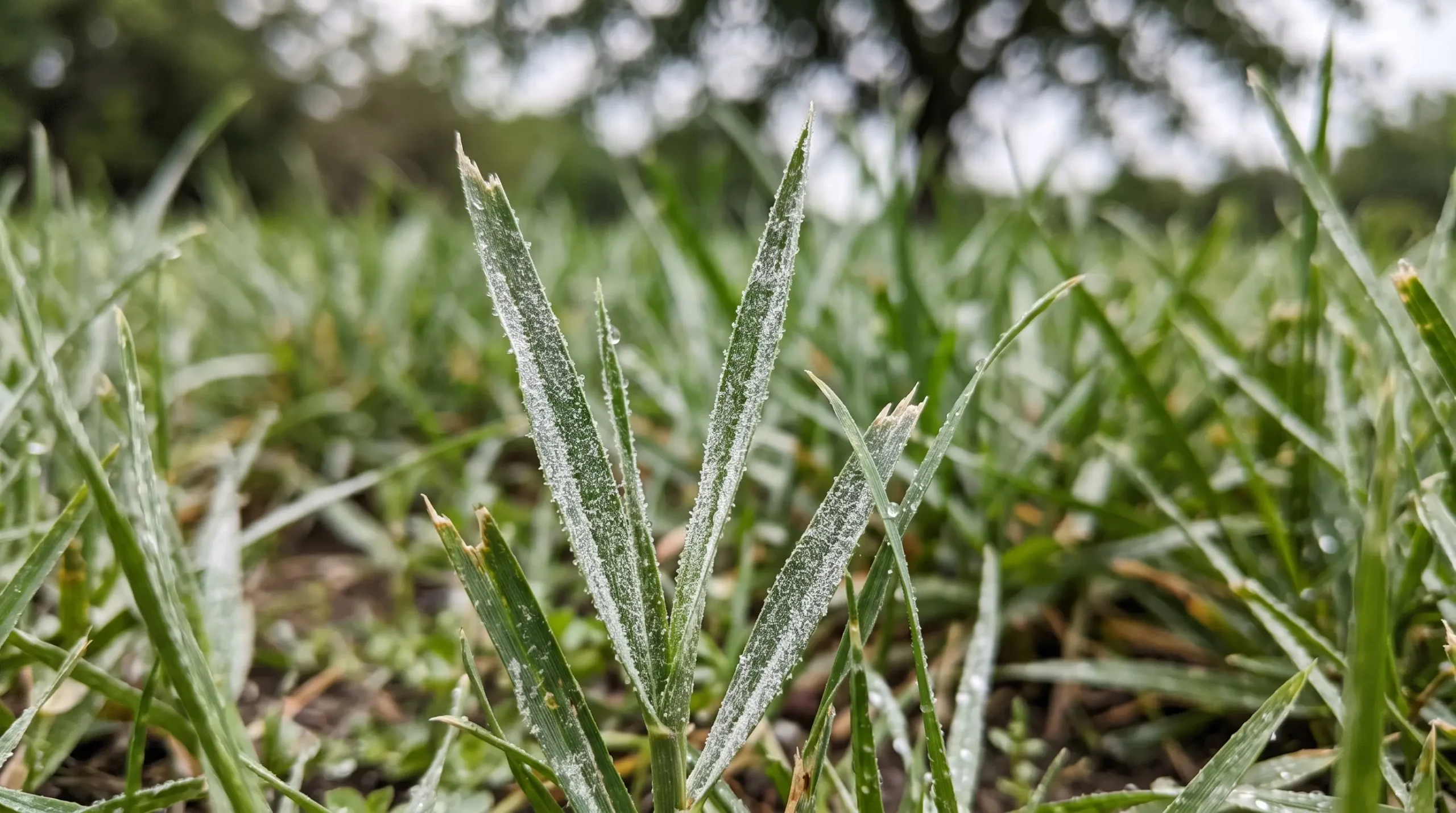
You walk across the lawn and your shoes come back dusted with something pale. Up close, whole blades look like somebody scattered flour over them. It wipes off on your fingers.
Nine times out of ten that white powder on lawn grass is powdery mildew, a fungus that lives on the leaf surface in shady, still corners of a yard. It looks alarming and it almost never kills anything. But two other things produce a similar pale coating, and one of them genuinely does damage turf, so it is worth spending two minutes identifying what you have before you treat it.
The quick way to tell them apart
Three things commonly leave a whitish deposit on grass. They look similar from a standing position and completely different from a crouch.
| Details | Powdery mildew | Slime mold | Dollar spot |
|---|---|---|---|
| What it is | A true fungus that infects the leaf | Not a fungus and not a plant pathogen at all | A true fungus that infects and kills leaf tissue |
| Up close | Fine grey-white dust, like talc | Slimy and greasy at first, then pinhead-sized pustules standing up off the blade | Short fuzzy white cobweb, only while dew is present |
| Colour range | Grey to white | White, grey, blue, yellow or orange | White, over tan lesions |
| Where on the lawn | Shaded areas, poor air movement | Anywhere, often in patches from a few inches to several feet | Spots roughly the size of a dollar coin, up to 6 inches or more on longer grass |
| Weather that brings it | Humid air but dry leaves, 60 to 70°F | Warm and wet, after prolonged leaf wetness | Night temperatures above 50°F plus 10 to 12 continuous hours of leaf wetness |
| What it needs from you | More light and air | A hose, or just time | Actual treatment |
| Does it harm the grass | Weakens it, rarely kills it | No, it does not infect plants at all | Yes, it can kill grass down to the soil |
The single most useful check is to look at the individual blade rather than the patch. Powdery mildew is a genuine dust that sits evenly along the leaf. Slime mold produces tiny round structures you can see standing proud of the surface, roughly the size of a pinhead. Dollar spot’s white is a cobweb of fungal threads that vanishes within an hour of the dew drying, and it leaves bleached lesions behind.
What powdery mildew actually is
The fungus is Blumeria graminis, which older references and some product labels still call Erysiphe graminis. It infects the leaf surface and draws nutrition from it, but the infection stays superficial. It does not destroy the stem, crown or root tissue, which is why a badly mildewed lawn recovers rather than dying.
Kentucky bluegrass is the main victim. Penn State Extension describes it as quite susceptible, and names Midnight, Merion and Windsor among the varieties that struggle. Fine fescues and tall fescue are, in the same source’s words, quite resistant. If your lawn is a bluegrass blend and the affected strip sits under a maple, that is the whole story in one sentence.
How it progresses
It starts as isolated wefts of fine grey to white spore masses on the upper surface of the leaves. Left alone, the growth thickens until it covers the whole blade and the leaf looks grey-white rather than green. A badly affected stand reads as dull white from a distance. Older infected leaves eventually yellow, and occasionally tiny dark specks called cleistothecia appear in the coating.
The fungus does not leave over winter. It survives unfavourable conditions by going dormant in the infected turf, which is why the same shaded strip mildews year after year while the open lawn ten feet away never does.
Why it appears where it appears
Powdery mildew wants four things at once, and a shaded corner supplies all of them.
- Shade. Penn State describes the disease as almost always associated with turf in shaded areas. Low light weakens the grass and keeps the microclimate cool.
- Cool air. Ohio State puts the favourable range at 60 to 70°F, which is why this shows up in spring and autumn rather than midsummer.
- High humidity, but dry leaves. This is the detail that separates it from almost every other lawn disease. Powdery mildew does not need free water sitting on the blade. Humid, still air is enough. Watering the lawn less will not stop it.
- Still air. Poor circulation lets that humid layer sit against the grass instead of being carried away.
That combination explains the classic pattern: a lawn that is fine everywhere except the north side of the house, or the strip along a solid fence, or under a dense tree canopy.
What to do about it
The honest answer is that powdery mildew is mostly a cosmetic problem, and the fix is a light and air problem rather than a spraying problem.
Fix the conditions, not the symptom
Get more light in. Prune overstory trees to let sunlight reach the turf, and thin shrubs that block airflow at ground level. This is the single most effective thing you can do, and it is the one both Penn State and Ohio State lead with. It is also the only one that stops the problem returning.
Improve air movement. Anything that lets humid air escape helps. Thinning the lower branches of trees, opening a gap in a solid boundary, and keeping the area free of dense ground cover all reduce the still, damp layer the fungus needs.
Change the grass if the shade is permanent. Where you cannot remove the shade, remove the susceptible grass instead. Overseeding with improved tall fescue or fine fescue puts a resistant species in the spot that keeps failing. Our guide to the best grass seed for shaded areas covers the choices, and overseeding without aerating explains how to get seed into an existing lawn.
Ease off the nitrogen. High nitrogen pushes soft, dense growth, which is exactly what the fungus prefers. A shaded area needs less feeding than an open lawn, not the same amount. If you are unsure of your rates, our roundup of lawn fertilizers lists application rates alongside each product.
Mow a little higher in shade. Grass in low light has less energy to rebuild leaf after cutting, so leaving it longer helps it cope. Our grass cutting height chart gives the right height for each species.
On fungicides
Penn State’s position is direct: except for highly managed turf areas, fungicides are not necessary for controlling this disease. Ohio State notes that preventative applications are possible, which reflects the reality that a golf course and a back garden are judged by different standards.
For a home lawn, the practical reading is that spraying treats the symptom while the shade and the still air remain, so the mildew returns. If the appearance genuinely bothers you and the conditions cannot be changed, our guide to lawn fungus treatments covers the options, and there is a separate piece on baking soda for lawn fungus for anyone wanting to try a home remedy first.
If it turns out to be slime mold
Slime molds are worth understanding because the correct response is almost nothing, and people routinely spray for them.
They are not fungi and they are not plant pathogens. Penn State classes them in the Protista kingdom: mobile, amoeba-like organisms that feed on bacteria rather than on your grass. Because they do not infect plants, they produce no disease symptoms at all. The only harm they can do is block sunlight from the leaf for long enough to cause some yellowing.
You will usually notice the slimy, translucent, creamy-white stage first. Within a few days it dries into pinhead-sized spore masses, usually grey or blue, and at that point the patch looks as though it has been dusted with soot. Patches run from a few inches to several feet and appear as rings, streaks or irregular shapes. They follow warm, wet weather.
The treatment is a hose. Spray the leaves and the deposit washes off. If it has already dried, mowing, raking or brushing removes it. Chemical control is unnecessary.
If it turns out to be dollar spot
This is the one that matters, because unlike the other two it kills grass.
Look for bleached-white or light-tan spots roughly the size of a dollar coin, expanding to 6 inches or more on higher-cut turf. The identifying feature is on the individual blade: white or light-tan lesions with light reddish-brown margins. The white fuzzy mycelium people notice is short and cobweb-like, visible in the morning while dew is present and gone once it dries.
NC State Extension puts the requirement at night temperatures above 50°F and 10 to 12 continuous hours of leaf wetness, which is why heavy dews on cool late-spring and early-summer nights bring it on. It slows once daytime highs sit consistently above 90°F. Left to develop, the grass in the spots can be killed to the soil surface and the spots merge into large blighted areas.
If the description matches what you are seeing, treat this as a real disease rather than a cosmetic one, and start with the lawn fungus treatment guide.
Things that are not a disease at all
Before assuming the worst, rule out the ordinary.
- Frost. Obvious in the moment, but a light frost on a cold morning genuinely looks like white dust from a window. It melts.
- Fertilizer or lime residue. Granules sitting on the surface, usually in the stripe pattern of a spreader pass, and concentrated where you turned or overlapped. Water it in.
- Dried spray residue. Some products leave a pale film as they dry. It disappears with the next rain.
The test for all three is simple. Disease follows the shade and the moisture. Residue follows wherever the machine went.
Common mistakes
Watering less to fix powdery mildew. Understandable, and wrong. Unlike most lawn diseases, this one does not need free water on the leaf. Humid air is enough. Cutting back on irrigation stresses grass that is already short of light.
Spraying and doing nothing else. The fungus survives dormant in the infected turf and the shade is still there in the spring. Without a change to light or air movement, you are committing to spraying every year.
Treating slime mold as an infection. It is not infecting anything. A hose does the job.
Feeding a shaded patch harder to green it up. High nitrogen produces the soft dense growth the fungus prefers. Shaded turf needs a lighter hand, not a heavier one.
Scalping it off. Cutting short removes leaf area from a plant already struggling for light. Raise the deck in shade rather than lowering it. The most common lawn care mistakes covers this and several related ones.
Frequently asked questions
Will powdery mildew kill my lawn?
Almost certainly not. Penn State states that it rarely kills turf and only weakens the plants, because the infection stays on the leaf surface without destroying stem, crown or root tissue. Badly affected turf looks poor and grows slowly, but it recovers when conditions improve.
Is it the same powdery mildew that attacks my squash and roses?
The symptom is the same, the fungus is not. The species that affects turfgrass, Blumeria graminis, is specific to grasses. It will not spread from your lawn to your vegetables or ornamentals.
Can I just wipe or mow it off?
You can remove the visible coating that way, but the infection is in the leaf and it returns. Mowing does help in one respect: it takes away the most heavily coated older leaves. It is not a cure.
Why is it only on one part of my lawn?
Because that part is shaded and the air is still. The disease is almost always associated with shaded turf, so the boundary of the affected area usually traces the boundary of the shade.
Does it come back every year?
In the same spot, usually yes, unless you change something. The fungus overwinters dormant in the infected turf, so an untreated shaded strip carries it to the following season.
What temperature does it appear at?
Ohio State puts the favourable range at 60 to 70°F, with high relative humidity. That means spring and autumn in most regions rather than the middle of summer.
My shaded area also has moss. Are they related?
They share a cause rather than causing each other. Moss and powdery mildew both thrive in damp shade with poor air movement, so the same fix helps both. See removing and preventing moss in lawns.
The short version
White powder on lawn grass is usually powdery mildew, and powdery mildew is a shade problem wearing a disease costume. Crouch down and look at a single blade: fine even dust means mildew, pinhead pustules mean slime mold, and a cobweb over tan lesions means dollar spot and needs proper attention.
For mildew, more light and more air movement solve it permanently, and a resistant grass solves it where the shade cannot be removed. Fungicide treats the look of it and not the cause. For more on keeping shaded and difficult areas healthy, our lawn care section collects the rest.