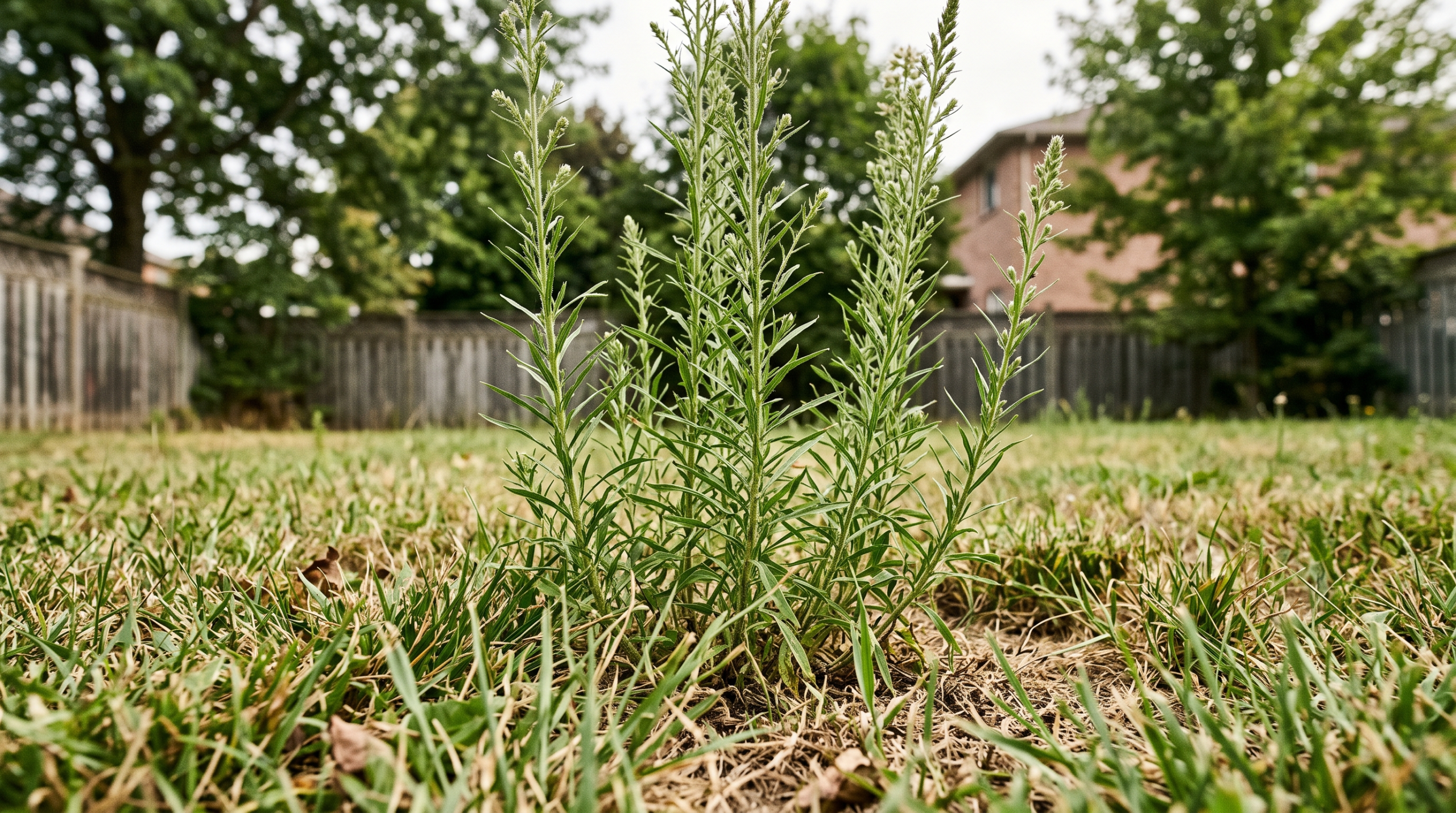
How to Get Rid of Horseweed in Your Lawn
If you’ve got a tall, gangly weed shooting up out of thin patches in your lawn, hard to pull, seemingly immune to whatever you sprayed on it last time, there’s a good chance you’re dealing with horseweed. It’s one of the more frustrating lawn weeds to deal with, partly because of how it grows and partly because a lot of the advice floating around about it doesn’t hold up.
This guide covers what horseweed actually is, why it shows up in lawns in the first place, and what genuinely works to get rid of it, based on university extension research rather than forum guesswork.
What Is Horseweed?
Horseweed’s scientific name is Erigeron canadensis, though you’ll still see it listed under its older name, Conyza canadensis, in a lot of older literature and product labels. It’s also commonly called marestail, Canadian fleabane, coltstail, or butterweed, depending on where you live.
It starts life as a low, ground-hugging rosette of hairy, slightly toothed leaves, easy to miss or mistake for something else. In spring, it bolts upright into a single, rigid stem, usually 3 to 6 feet tall, though it can reach up to 10 feet in ideal conditions. The stem branches near the top once it matures, and from early summer into fall it produces small, inconspicuous white flowers, followed by an enormous number of wind-dispersed seeds. A single mature plant can produce up to 200,000 seeds, which is a large part of why it spreads so fast once it gets a foothold, and why those seeds can travel well over 100 miles on the wind.
Why Horseweed Shows Up in Lawns
Horseweed isn’t picky about soil, but it is picky about light and competition. It needs bare, disturbed, or thin ground to get established, and it thrives in compacted soil and full sun. That’s exactly what you get in a lawn with bare patches, worn paths, thin turf from over-mowing or drought stress, or compacted soil from foot traffic. A dense, healthy, actively growing lawn is genuinely one of the best defenses against it, because horseweed seedlings don’t compete well against established turf.
Life Cycle and Why Timing Matters
This is the part most DIY advice gets wrong. Horseweed isn’t a simple spring-to-fall annual. It behaves as both a winter annual and a summer annual, which means it can germinate in late summer or fall, overwinter as a rosette, and bolt the following spring, or it can germinate fresh in spring and mature over summer. Because of that extended, split germination window, a single treatment timed for “spring weeds” often misses a whole batch of plants that germinated the previous fall.
That’s also why timing your treatment to the plant’s growth stage matters more than the calendar. Horseweed is far easier to control while it’s still a seedling or rosette, ideally under about 12 inches tall, than once it has bolted into a tall, woody stem.
How to Get Rid of Horseweed in Your Lawn
Pull It While It’s Young
Horseweed has a single taproot with some fibrous roots, and while that makes it more stubborn than a shallow-rooted weed, it’s still manageable to hand-pull, especially at the rosette stage or shortly after bolting. Pull the entire root, not just the top growth, since any remaining root can send up new growth. The most important rule here: get it out before it flowers. Killing a plant after it has already released seed doesn’t do much for you, since those seeds are already in your soil and on their way into your neighbor’s yard too.
Fix the Conditions That Let It In
According to NC State Extension’s turf weed guidance, proper turf management is one of the most effective long-term controls for this kind of broadleaf annual. That means:
- Mowing at the correct height for your grass type, since scalped or overly short turf opens up bare soil for horseweed seedlings to establish. Our Grass Cutting Height Calculator can help you dial in the right height for your specific grass.
- Fertilizing and watering to keep turf dense and actively growing rather than stressed or thin.
- Core aerating compacted areas, since horseweed favors compacted soil and aeration helps your turf outcompete it.
None of this eliminates an existing infestation on its own, but it closes the door on new seedlings getting a foothold, which matters given how many seeds one plant can produce.
Use a Broadleaf Herbicide, and Don’t Rely on 2,4-D Alone
For an established lawn, a selective broadleaf herbicide is usually the most reliable chemical option, but the specific active ingredient matters. University extension turf specialists consistently point out that 2,4-D by itself often isn’t strong enough on its own, especially on plants that have already bolted. A more reliable approach is a product that combines 2,4-D with dicamba, triclopyr, or clopyralid, or a product built around quinclorac, which extension agents note can provide good control on its own.
A few things worth knowing before you spray:
- Apply while the plant is young and actively growing. Products are far more effective on horseweed under about 12 inches tall than on a tall, woody, already-flowering plant.
- Don’t count on glyphosate (Roundup) for spot treatment. Glyphosate-resistant horseweed has been confirmed across large parts of the United States, so a product built around glyphosate alone may do very little, even at label rates.
- Watch drift and temperature. 2,4-D and dicamba are prone to volatilizing and drifting in hot weather, which can injure nearby trees, shrubs, and garden plants. Spraying on a calm day under 80°F, with a nozzle that produces larger droplets, cuts down on this risk significantly.
- Read the label for what it’s rated for. Not every broadleaf herbicide is labeled safe for every turfgrass species, and rates differ for fall versus spring applications.
Don’t Expect Mowing Alone to Solve It
Mowing is a genuinely useful cultural practice for keeping your lawn dense, but it isn’t a reliable way to kill horseweed once it has bolted. Research from the University of Arizona notes that horseweed doesn’t branch until it’s a couple of feet tall, but cutting it at that stage tends to cause it to branch out rather than kill it. In practice, that means mowing a mature horseweed plant can leave you with a bushier, more established plant rather than a dead one. Mowing is still worth doing to prevent seed set if you catch plants before they flower, but treat it as a supporting tactic, not the main plan.
Be Realistic About Pre-Emergent Herbicides
Pre-emergent products can help, but horseweed’s extended, split germination window (fall and spring) makes it a harder target than something like crabgrass, which germinates in a single, more predictable window. A single fall application can miss plants that germinate weeks later in spring, so if you go this route, plan on watching for breakthrough growth and following up with a post-emergent treatment rather than assuming one application will cover the whole season.
A Few Things Worth Knowing
Horseweed can actually suppress other plants around it. Peer-reviewed research has found that horseweed produces allelopathic compounds, phenolic and other phytotoxic substances released from its leaves and roots, that can inhibit the germination and growth of nearby plants. This is part of why it can dominate a bare or thin patch so quickly once it’s established there.
It’s toxic to horses. Despite the common name, horseweed isn’t good for horses. Washington State University’s Hortsense fact sheet notes that its leaves and flowers contain a compound that’s particularly irritating to horses, which is worth knowing if you keep a lawn near a pasture or paddock.
Frequently Asked Questions
Sources consulted and verified:
- NC State Extension Publications, “Horseweed“
- University of Maryland Extension, “Marestail: Identification and Management in Nursery and Landscape Settings“
- University of Delaware Extension, via Ask Extension, “Horse weed / marestail“