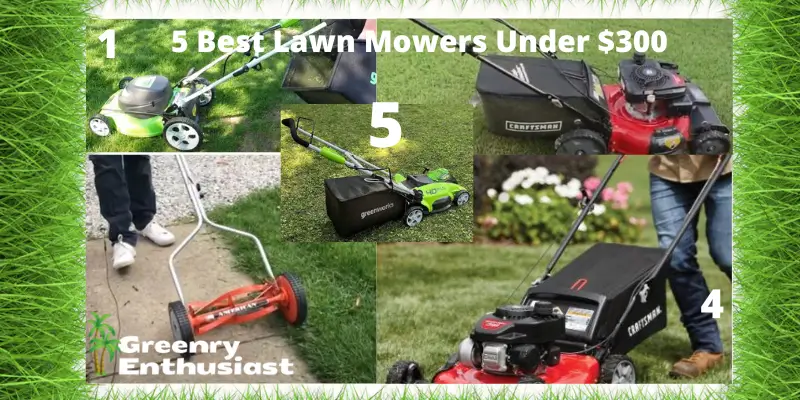
How to Choose a Lawn Mower Under $300 — Complete Buying Guide
A budget of $300 is actually enough to buy a capable lawn mower for most residential lawns — if you know what to look for. The problem is that the market is flooded with options, and it is easy to spend $300 on the wrong machine for your lawn type and end up frustrated.
This guide walks you through every important decision point so you can choose the right lawn mower under $300 for your specific situation — lawn size, terrain type, grass thickness, and how much effort you want to put in each time you mow.
First Question: What Type of Lawn Do You Have?
Before looking at any specific mower features, answer these three questions about your lawn:
How big is your lawn?
- Under 1/4 acre (small home lawn) — almost any mower under $300 will work
- 1/4 to 1/2 acre (medium lawn) — you need a self-propelled or wider deck mower
- Over 1/2 acre — a budget under $300 will be a stretch; consider saving for a riding mower
Is your terrain flat or sloped?
- Flat terrain — any type works
- Moderate slopes — rear-wheel drive self-propelled is much easier
- Steep slopes — self-propelled with large rear wheels is essential
How thick and tall does your grass get?
- Fine, regularly mowed grass — any mower handles this
- Thick or fast-growing grass — you need a more powerful engine (gas) or higher-amp motor (electric)
Your answers to these three questions narrow down your options significantly before you even look at specific features.
Types of Lawn Mowers Under $300
Push Reel Mowers — Cheapest Option
Push reel mowers have no engine. A set of spinning blades rotates as you push the mower forward, cutting grass with a scissor-like action.
Best for: Small flat lawns under 1/8 acre with fine, regularly maintained grass.
Advantages:
- Cheapest option — most models cost $80 to $150
- Zero maintenance — no oil, no fuel, no spark plugs
- Completely silent operation
- No emissions
- Lightweight and easy to store
Disadvantages:
- Cannot cut grass over 4 inches tall without clogging
- Hard work on larger lawns — tiring to push
- Does not cut thick or coarse grass well
- Cannot mulch or bag clippings
Who should buy this: Apartment dwellers with small patches of grass, or anyone with a tiny flat lawn who mows very regularly.
Corded Electric Mowers — Best Value for Small Lawns
Corded electric mowers plug into a standard household outlet via an extension cord. They provide consistent power throughout the entire mowing session since they are not limited by battery life.
Best for: Lawns up to 1/4 acre that are within reach of a power outlet.
Advantages:
- Lower cost than battery models — typically $120 to $200
- Unlimited runtime — never runs out of power mid-mow
- Lighter weight than gas mowers
- Low maintenance — no oil changes, no fuel
- Consistent power throughout the mow
Disadvantages
- Extension cord limits range and can be a tripping hazard
- Cord management requires attention during mowing
- Not suitable for wet grass — electric shock risk
- Less powerful than gas mowers
What to look for:
- Minimum 12 amp motor for cutting through thick grass
- At least 20-inch cutting deck for efficiency
- Single-lever height adjustment for convenience
- 2-in-1 or 3-in-1 discharge options (mulch, bag, side discharge)
Battery-Powered Cordless Mowers — Most Convenient
Battery-powered mowers offer the convenience of no cord with the low maintenance of electric power. Most residential models in the under $300 range use 40V lithium-ion batteries.
Best for: Lawns up to 1/4 to 1/3 acre where cord-free convenience is a priority.
Advantages:
- No cord to manage — complete freedom of movement
- Quiet operation
- Low maintenance
- Lightweight design
Disadvantages:
- Limited runtime — most 40V batteries last 30 to 45 minutes per charge
- Battery replacement is expensive when the time comes
- Some models sold without battery and charger — check before buying
- Less powerful than gas on thick grass
What to look for:
- 40V minimum battery voltage for adequate power
- Battery and charger included in the package — many budget models do not include them
- At least 16-inch cutting deck
- Runtime of at least 30 minutes on a full charge
Gas Push Mowers — Most Powerful Under $300
Gas-powered push mowers are the workhorse option in the under $300 category. They offer significantly more cutting power than electric options and can handle thicker, taller, and wetter grass.
Best for: Lawns up to 1/3 acre with thicker grass, or any lawn where cutting power is the priority.
Advantages:
- Most powerful option under $300
- Not limited by cord or battery
- Can handle thick, tall, and wet grass better than electric options
- Widely available replacement parts
Disadvantages:
Requires regular maintenance — oil changes, air filter, spark plug
Heavier than electric options
Produces emissions
Louder than electric mowers
Fuel storage and handling required
What to look for:
- Minimum 140cc engine for adequate power
- 21-inch cutting deck for efficiency
- 3-in-1 discharge options (mulch, bag, side discharge)
- At least 6 cutting height positions
Gas Self-Propelled Mowers — Best for Larger or Sloped Lawns
Self-propelled mowers drive themselves forward — you steer and guide, but the mower does the walking. This makes a significant difference on larger lawns and sloped terrain.
Best for: Lawns of 1/4 to 1/2 acre, especially with slopes or thick grass.
Advantages:
- Significantly less effort on larger lawns and slopes
- More powerful engines than push mowers
- Large rear wheels provide excellent traction on slopes
- Rear-wheel drive handles slopes better than front-wheel drive
Disadvantages:
At the upper end of the $300 budget — some models exceed it
Heavier than push mowers
More complex — more components that can require maintenance
What to look for:
- Rear-wheel drive for slope performance
- 159cc or larger engine
- Variable speed self-propulsion — adjustable pace
- Large rear wheels (at least 10 inches) for rough terrain
Key Features to Compare When Shopping Under $300
Cutting Deck Width
The cutting deck width determines how wide a strip of grass you cut with each pass. A wider deck means fewer passes to cover the same area — less time mowing.
| Deck Width | Best For |
| 14 to 16 inches | Tiny lawns, tight spaces, reel mowers |
| 18 to 20 inches | Small to medium lawns |
| 21 inches | Medium lawns, most efficient option under $300 |
For most homeowners, a 20 to 21-inch deck is the sweet spot in the under $300 budget range.
Cutting Height Adjustment
Look for at least 5 to 7 cutting height positions, adjustable from around 1 inch to 4 inches. More positions give you finer control over your cut height.
Single-lever adjustment — where one lever adjusts all four wheels simultaneously — is far more convenient than adjusting each wheel separately. Pay attention to this when comparing models.
Discharge Options
Mulching — Clippings are chopped finely and deposited back onto the lawn as fertilizer. Best for regular mowing when grass is not too long.
Rear bagging — Clippings are collected in a bag attached to the rear of the mower. Best when grass is long or when you want a clean appearance.
Side discharge — Clippings are thrown out to the side. Useful for very long or thick grass that would clog a mulching blade.
A 3-in-1 mower that does all three gives you the most flexibility. Most mowers under $300 offer at least 2-in-1 (mulch and bag).
Wheel Size and Type
Larger rear wheels handle rough terrain and slopes better. For flat, smooth lawns, standard wheels are fine. For uneven or sloped lawns, look for rear wheels of at least 8 to 10 inches in diameter.
Hard plastic wheels are cheaper but wear faster. Ball-bearing wheels roll more smoothly and last longer — worth paying a little more for.
Electric vs Gas — Which Should You Choose Under $300?
| Factor | Electric (Corded/Battery) | Gas |
| Maintenance | Very low — no oil or fuel | Regular — oil, filter, spark plug |
| Power | Moderate | High |
| Noise | Quiet | Loud |
| Cost to run | Low — electricity only | Ongoing fuel cost |
| Best lawn size | Up to 1/4 acre | Up to 1/2 acre |
| Thick grass | Struggles | Handles well |
| Slopes | Moderate | Good |
| Startup | Instant button start | Pull cord (sometimes difficult) |
Bottom line: For small, flat lawns with regular mowing — go electric. For larger lawns, thick grass, or significant slopes — gas is the better choice even in the budget category.
What to Check Before Buying
Is the battery included? Many cordless electric mowers in the under $300 price range are sold as “tool only” — meaning the battery and charger are sold separately and can add $80 to $150 to the total cost. Always check what is included in the box before comparing prices.
What is the warranty? Budget mowers typically come with 2 to 3 year warranties. Check whether the warranty covers both parts and labor, and what the process is for making a claim.
Are replacement parts available? Blades, belts, spark plugs, and air filters all need replacing over time. Check that your chosen model has readily available parts before buying. Obscure brands sometimes become difficult to service after a year or two.
What do owners say about starting reliability? Pull-start gas engines are notorious for being difficult to start, especially after sitting unused over winter. Look for user reviews that specifically mention starting ease.
Does it come fully assembled? Most budget mowers require some assembly — typically attaching the handle and grass bag. Check reviews for assembly difficulty, especially for the handle connection, which is a common pain point on budget models.
Maintenance Tips to Make Your Mower Last
A well-maintained budget mower can last 8 to 10 years. Neglect can cut that to 2 to 3 years. Here is the basic maintenance schedule:
Every mowing session:
- Check the oil level (gas mowers)
- Clear any grass buildup from under the deck
- Inspect the blade for damage
Every 25 hours of use (or once per season):
- Change the engine oil (gas mowers)
- Clean or replace the air filter
- Check and replace the spark plug if needed
- Sharpen or replace the cutting blade
End of season:
- Run the fuel tank empty or add fuel stabilizer before winter storage
- Clean the entire mower thoroughly
- Lubricate wheel axles and height adjustment mechanisms
- Store in a dry, covered location
FREQUENTLY ASK QUESTIONS (FAQs)
CONCLUSION:
Choosing a lawn mower under $300 comes down to matching the machine type to your lawn. A small flat lawn is well served by a corded or battery electric mower — easy to maintain, quiet, and capable. A larger lawn or one with thick grass and slopes needs a gas mower, even at the budget level, because the extra power makes a real difference.
Focus on cutting deck width (20 to 21 inches for most lawns), discharge options (3-in-1 gives the most flexibility), and engine or motor size (bigger is better within your budget). Check that batteries and chargers are included if buying cordless, confirm warranty terms, and verify that replacement parts are available for your model.
A well-chosen $300 mower, properly maintained, will give you many years of reliable service.
Related Posts:
- How Often Should You Mow Your Lawn?
- Best Cutting Height for a Healthy and Beautiful Lawn
- Are Lawn Mower Blades Reverse Threaded?
- What to Look for in a Lawn Mower for Rough Terrain
- How to Do a Lawn Mower Tune-Up Yourself