Dollar Spot Lawn Disease: How to Identify and Treat It
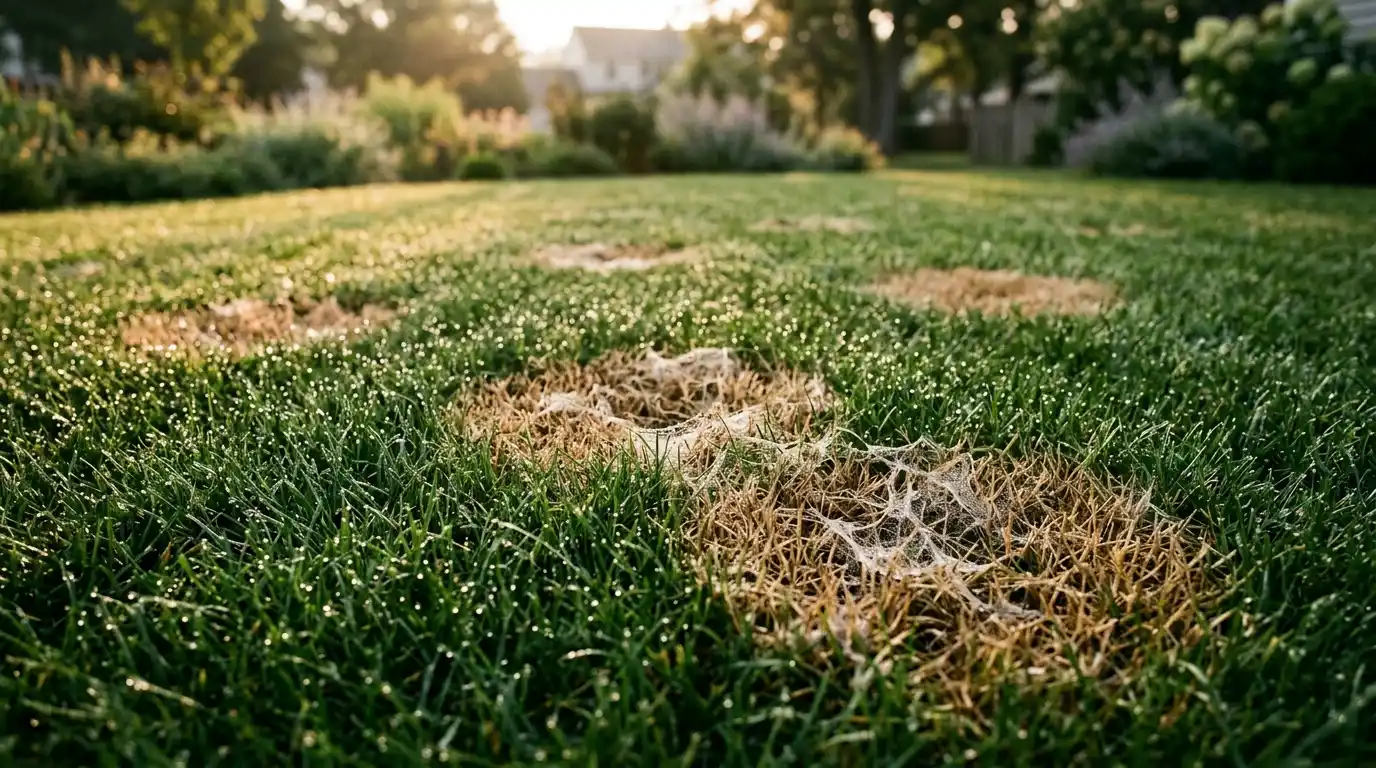
Straw-coloured patches turn up across the lawn, each one a few inches wide, and by mid-morning there is nothing to see but the patches themselves. Get out early enough and the same spots carry a fine white webbing that disappears once the dew burns off.
That is dollar spot, and of the common lawn diseases it is one of the few that will actually kill the grass in those patches rather than just discolouring it. The good news is that it responds to changes in how you feed, water and mow, more reliably than it responds to anything you spray.
One thing to get straight first, because nearly every guide online gets it wrong for home lawns.
It is not the size of a silver dollar on your lawn
The disease is named for how it looks on a golf course putting green, cut to an eighth of an inch. At that height the spots really are about the size of a coin. Your lawn is not cut to an eighth of an inch.
Penn State Extension breaks the size down by mowing height:
| Where | Cut height | Spot size |
|---|---|---|
| Putting greens | 1/8 inch or less | About a silver dollar |
| Golf fairways and tees | Around 1/2 inch | 1 to 3 inches |
| Home lawns and athletic fields | 2 to 3 inches | 2 to 5 inches |
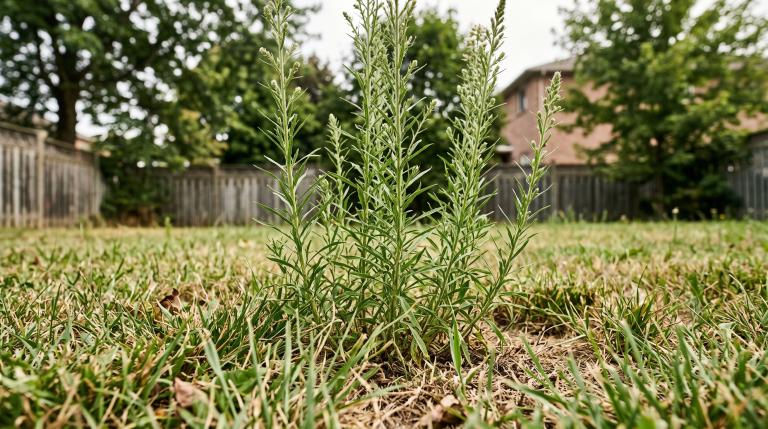
NC State Extension puts higher-cut turf at 6 inches or more. So on a normal lawn you are looking for patches somewhere between two and six inches across, not coins. People rule dollar spot out because their patches are “too big”, and that is the single most common identification mistake with this disease.
In severe cases the spots merge and you get large blighted areas instead of distinct circles, which makes it look like drought stress or a fertiliser burn.
The check that actually confirms it
Patch size and colour will get you close. The confirmation is on a single blade of grass.
Pull a few blades from the edge of a patch, where the grass is dying rather than already dead, and look along the length of the blade. Dollar spot produces a tan or straw-coloured lesion with a distinct reddish-brown border running across the blade. As the lesion spreads sideways it pinches in the middle, and that produces the hourglass shape that both Penn State and Texas A&M describe as the classic symptom.
Two supporting signs:
The blades stay upright. NC State notes that affected leaves typically remain standing rather than collapsing. The lesion girdles the blade and the part above it dies slowly, so you get a bleached upper section on a blade that is still stood up.
Morning webbing. Short, fuzzy white mycelium appears on affected turf in the early morning while dew is present, or after rain. It looks like fine cobweb sitting on the grass. It is gone within an hour of the dew drying, so if you only ever look at the lawn in the afternoon you will never see it.
Start with yellow-green blotches on the leaves, which is the earliest stage before the tan lesion forms.
Why you will find three different names for it
Look this up and you will find the fungus called three different things, which is genuinely confusing rather than pedantic.
The current name is Clarireedia jacksonii. It was known for decades as Sclerotinia homoeocarpa, then reassigned to Rutstroemia floccosum around 2010, and DNA work later placed it in a new genus altogether. Texas A&M lists it as Clarireedia jacksonii, “recently renamed from Sclerotinia homoeocarpa“. Some university pages still carry the older names, and product labels are slower still.
If a fungicide label mentions Sclerotinia homoeocarpa, it is talking about dollar spot. You are not looking at a different disease.
The detail that changes how you treat it
Here is the fact almost nobody mentions, and it is the most practically useful thing on this page.
This fungus does not produce spores.
Most lawn diseases spread on airborne spores, which is why the usual advice is about air circulation and leaf wetness. Dollar spot does not work that way. According to Penn State, it spreads by bits of mycelium carried on infected plant parts, primarily grass clippings, and it can be moved around by water, by equipment, and on shoes.
The practical consequences are immediate:
- Your mower is the main vector. Mowing an infected lawn picks the fungus up and lays it down everywhere else you cut.
- Bag the clippings while it is active. Normally returning clippings is good practice. While dollar spot is running, clippings are how it travels.
- Rinse the deck after cutting an affected area, before moving to clean turf.
- Direction matters. Cut the healthy parts of the lawn first and the affected patches last, rather than dragging the fungus through clean grass.
This also creates a genuine conflict in the advice you will read, and it is worth knowing about. Dragging or mowing off the morning dew reduces dollar spot significantly, because it shortens the leaf wetness period. But NC State adds the caveat that these same practices “can spread the disease if it is actively developing”. So dew removal is a preventive measure for a lawn that is at risk, not a treatment for a lawn that already has it. Once you have visible patches, dragging a hose across the lawn is spreading mycelium.
What brings it on
The fungus overwinters as thick-walled crusts of mycelium, called pseudosclerotia, inside dormant infected tissue. It does not arrive from somewhere else each year. It wakes up in the lawn it was already in.
Conditions that set it off:
- Temperature. Peak activity sits between 60 and 85°F with high humidity. NC State puts the starting point at spring nights above 50°F, and notes activity slows once daytime highs consistently exceed 90°F.
- Long leaf wetness. The fungus needs 10 to 12 continuous hours of wet leaves. That is why warm days followed by cool nights are the worst combination: the temperature drop produces heavy dew that sits until well after sunrise.
- Low nitrogen. Covered below, and this is the big one.
- Frequent light watering. Penn State is direct that the most severe cases occur on turf receiving closely spaced summer irrigation.
Peak season is late summer, with a second run through early to mid autumn.
How to treat it
Cultural controls do most of the work here, and unusually for a lawn disease the first step is to feed the lawn rather than hold back.
Feed it, do not starve it
This is counterintuitive, because most lawn problems get blamed on too much fertiliser. Dollar spot is the opposite.
Penn State states that severity increases on turf that does not receive enough nitrogen, or when the foliage is growing slowly, and that late spring nitrogen applications help to minimise it. NC State says nitrogen-deficient turf is both more prone to the disease and slower to recover from the damage. Illinois Extension notes severity rises on dry soils deficient in nitrogen.
The mechanism is simple: the fungus attacks leaf tissue, so a lawn producing new leaf outgrows the damage. A lawn that is barely growing cannot. If your patches showed up on turf you have not fed since spring, that is the likeliest single cause. Our roundup of lawn fertilizers lists nitrogen content and application rates for each product.
Water deeply, rarely, and early
Three separate changes, all pulling in the same direction:
Deep and infrequent. Penn State recommends cycles that apply more water less often, wetting the entire root zone, rather than frequent light applications. Illinois gives the same advice. Little and often keeps the leaf surface wet repeatedly, which is exactly what the fungus needs.
Early morning. NC State is specific: irrigate between midnight and 6 AM. The grass is already wet with dew at that point, so you are not adding a separate wetness period, and the leaves dry at the normal time.
Never in the evening. Watering in the late afternoon or evening adds hours of leaf wetness on top of the overnight dew, which comfortably clears the 10 to 12 hour threshold the fungus needs. Our guide to how often to water your lawn covers the timing and the amounts in full, including how to measure what your sprinkler actually puts down.
Raise the mower
Low mowing encourages dollar spot. Cutting higher leaves more leaf area, which means more capacity to grow through the damage, and it usually improves root depth as well.
Raise the deck, but stay inside the range for your grass type rather than just going as high as the mower allows. Our grass cutting height chart gives the correct range for each species, along with the height you should never cut below.
Then, and only then, fungicides
For a home lawn, cultural control usually settles it, and there is a specific reason to be cautious about reaching for a spray.
Fungicide resistance in this pathogen is real and documented. Penn State notes resistance has developed to penetrant fungicides and recommends alternating modes of action, mixing contact and penetrant products, or using contact products only. Repeatedly applying the same active ingredient is how resistance builds in the first place.
There is also a labelling issue worth knowing. NC State’s product list for dollar spot marks most entries as not labelled for home lawn use, because the majority of dollar spot research and product development is aimed at golf courses. Check the label covers residential lawns before buying.
If you do want to treat, our guide to lawn fungus treatments covers what is available for home use, and there is a separate piece on baking soda for lawn fungus for anyone who wants to try a home remedy before buying anything.
Is dollar spot actually killing the grass
Partly, and the distinction matters for whether you need to reseed.
Dollar spot is a foliar disease. The fungus attacks leaf tissue, not roots or crowns. But NC State is clear that if the disease keeps developing, the grass in the spots can be killed right down to the soil surface, and separate spots merge into large blighted areas.
So a lawn caught early recovers on its own once it is growing again. A lawn left through a bad run can end up with genuinely dead patches that need seed. This is the practical difference between dollar spot and the diseases that only discolour the grass, and it is the reason it is worth identifying properly rather than waiting to see what happens.
What else it might be
Three things get mistaken for dollar spot, and one of them runs in the opposite direction.
| Direction | Dollar spot | Brown patch | Powdery mildew |
|---|---|---|---|
| Patch size on a lawn | 2 to 6 inches | Often a foot or more, roughly circular | No patches, follows the shade |
| On the blade | Tan lesion, reddish-brown border, hourglass | Irregular tan lesions with dark border | Fine white dust coating the whole blade |
| Morning sign | Fine white cobweb mycelium | Sometimes a dark smoke ring at the edge | Nothing, the coating is there all day |
| Nitrogen | Too little brings it on | Too much brings it on | Shade, not fertility |
| Kills the grass | Yes, down to the soil | Often only the leaves | Rarely |
The nitrogen row is worth reading twice. Dollar spot and brown patch respond to opposite mistakes, so treating one as the other makes it worse. If you are unsure which you have, do not add nitrogen until you are sure. Our guide to identifying and treating brown patch covers the other side of it, including why the smoke ring everyone tells you to look for does not show up on a home lawn.
If the white you are seeing coats the whole blade like flour rather than sitting on it as a cobweb, and it does not vanish when the dew dries, you are probably looking at something else entirely. Our guide to white powder on lawn grass separates powdery mildew, slime mould and dollar spot properly.
Common mistakes
Ruling it out because the patches are too big. The silver dollar comparison describes putting greens. On a lawn cut at 2 to 3 inches, expect 2 to 5 inches, sometimes more.
Cutting back on fertiliser. Reasonable instinct, wrong disease. Low nitrogen is a cause here, not a cure.
Watering a little every evening. The worst possible combination. Frequent light watering plus evening timing gives the fungus the long wetness period it needs.
Dragging the dew off a lawn that already has it. Good prevention, bad treatment. Without spores, the fungus moves on mycelium, and dragging spreads it.
Mowing the worst patches first. The mower carries it into clean grass. Do the healthy areas first.
Spraying the same product repeatedly. Resistance to penetrant fungicides is already documented in this pathogen. Rotate modes of action or stick to contacts.
Frequently asked questions
Will dollar spot go away on its own?
Often, if the weather changes and the grass is growing. Activity slows once daytime highs consistently exceed 90°F, and a well-fed lawn grows through the damage. A nitrogen-deficient lawn recovers more slowly, and patches can be killed to the soil surface in the meantime.
Does dollar spot come back every year?
It can, because the fungus overwinters as pseudosclerotia in dormant infected tissue in the lawn itself rather than blowing in each season. Changing the conditions it needs is what breaks the cycle.
Which grasses get it worst?
NC State says all turfgrass species are affected, with certain cultivars of creeping bentgrass, perennial ryegrass and Kentucky bluegrass very susceptible while others are fairly tolerant. Texas A&M adds that bermudagrass and zoysiagrass can be infected, while St. Augustinegrass and centipedegrass are rarely damaged.
Can I still mow a lawn that has dollar spot?
Yes, and you should keep mowing, but bag the clippings while it is active and cut the affected areas last. The fungus travels on clippings and equipment, so returning clippings to the lawn spreads it.
Should I water more because the patches look dry?
Not more often. Dollar spot is worse on frequently irrigated turf, and the patches are fungal damage rather than drought. Water deeply, less often, and early in the morning.
Is it the same fungus as brown patch?
No, and the two respond to opposite fertility mistakes. Brown patch is driven by excess nitrogen, dollar spot by too little.
Do I need to reseed the patches?
Only where the grass has actually died to the soil surface. Grass that is only blighted at the leaf recovers once it is growing. Give it a few weeks of decent growing conditions before deciding.
The short version
On a home lawn, dollar spot means tan patches a few inches across, an hourglass lesion with a reddish-brown border on the individual blades, and fine white cobwebbing that is only there first thing in the morning.
Feed it, water deeply and early rather than lightly and often, raise the mower, and bag the clippings until it stops spreading. Those four changes handle most home lawn outbreaks without a fungicide, and they are also what stops it coming back next year. For more on keeping turf healthy through the difficult months, our lawn care section collects the rest.