Brown Patch Lawn Disease: How to Identify and Treat It
A lawn that looked fine on Friday has a brown circle in it by Sunday, three feet across, with the grass inside thinned and flattened. Nothing was sprayed, nothing was spilled, and the sprinkler has been running as usual.
That speed is the giveaway. Ohio State Extension notes that a large blighted area can develop within 24 to 48 hours, which is faster than drought, faster than grubs, and faster than almost anything else that turns a lawn brown.
Brown patch is caused by Rhizoctonia solani, and unlike most lawn problems the usual response makes it worse. Watering more feeds it. Feeding it feeds it. Getting this one right mostly means doing less.
What brown patch looks like on a home lawn
Search for brown patch and nearly every result tells you to look for a dark “smoke ring” around the edge of the circle. On a home lawn you will usually not find one, and people rule the disease out because of it.
NC State Extension is specific about why. The smoke ring appears on close-cut turf, an inch or under, which means golf greens and fairways. It also only shows when the leaves are actually wet or humidity is near 100%, so it fades by mid morning. On turf cut above an inch, which is every normal lawn, you get visible lesions on the leaves instead.
So look for this on a lawn:
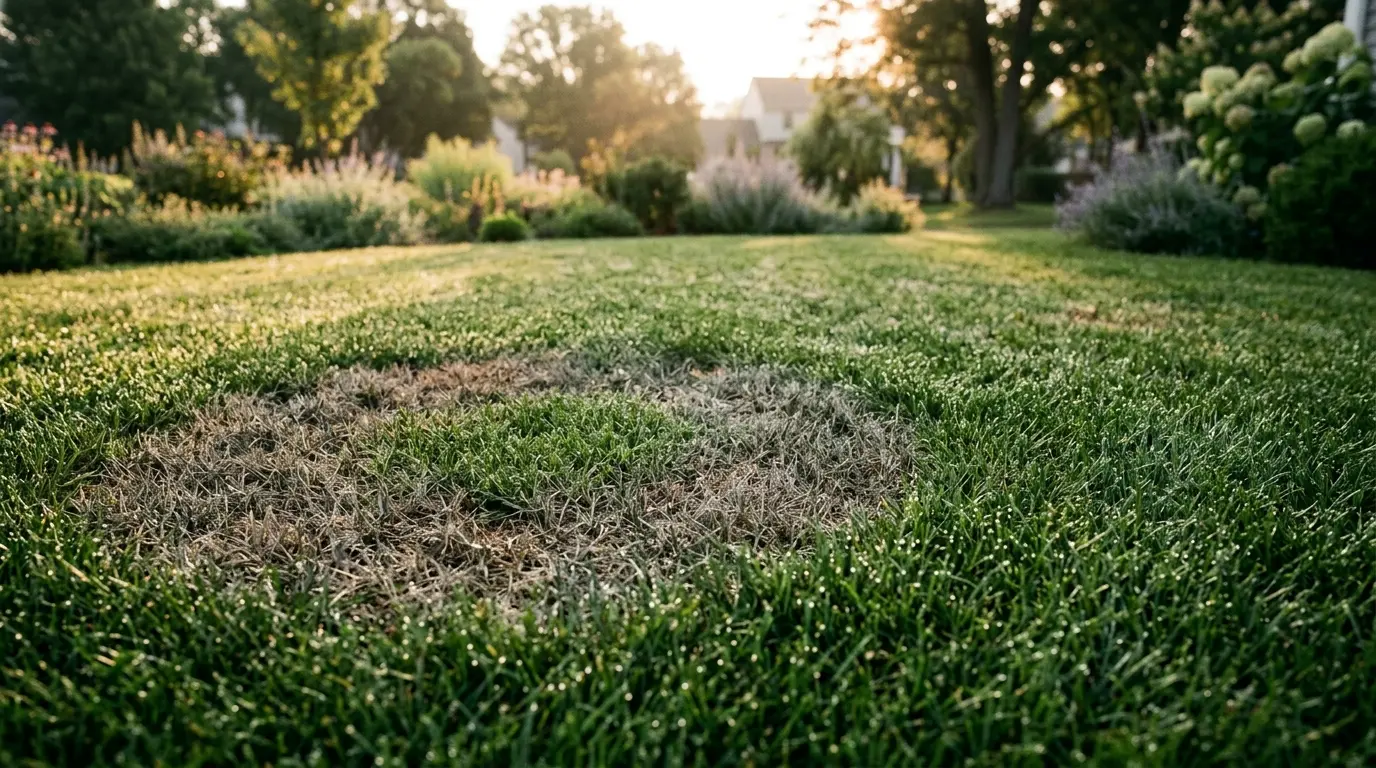
- Roughly circular patches, 6 inches to several feet across on turf cut above an inch. Ohio State puts high-cut patches at 2 to 3 feet with general thinning rather than complete kill.
- A doughnut shape as it develops. The centre often starts recovering while the edge keeps expanding, so the patch becomes a ring rather than a disc.
- Grass that looks grey and grubby rather than cleanly straw-coloured. Ohio State draws that contrast directly against dollar spot, which is a lighter tan.
- Diffuse thinning with no circle at all. Penn State notes brown patch can appear as general blighting of the foliage without any patch pattern, which is the version that gets mistaken for heat stress.
The check that confirms it
Pull a few blades from the edge of a patch and look along the blade.
Brown patch produces irregular tan or light brown lesions with a distinct dark brown border. The shape is the point: the lesions are irregular, not neat. Clemson describes them as small, irregular tan leaf spots with dark brown borders on cool-season grasses.
If you are out at dawn on a humid morning you may also see small amounts of grey, cottony mycelium growing among the leaves. On close-cut turf it is typically absent, and on a lawn it is gone once the dew dries.
Why it appeared overnight
The fungus was already there. It overwinters as sclerotia, which are compact hardened masses of mycelium, sitting either inside infected grass tissue or loose in the soil. Penn State notes these can survive for years without a host.
When conditions turn, the sclerotia germinate and produce mycelium that infects leaf and stem tissue and then spreads from plant to plant through the canopy. This fungus produces no spores at all. That single detail explains the shape of the damage: it has to grow outward through contact, so it advances as an expanding circle rather than appearing in scattered spots.
The conditions that trigger it:
| Factor | Threshold |
|---|---|
| Night temperature | Starts once nights stop dropping below about 60°F, severe when lows stay above 70°F |
| Day temperature | 80°F and above, worst above 90°F |
| Leaf wetness | 10 to 12 continuous hours |
| Humidity | Rainy weather and near 100% humidity speed it sharply |
| Season | May to September, peaking in midsummer |
Night temperature is the one to watch. A run of humid nights that never cool below 70°F is the setup, and that is exactly when a lawn is least able to recover, because cool-season grasses grow slowly in that heat.
Which grasses get it
Tall fescue, perennial ryegrass and the bentgrasses are the ones that suffer. Penn State lists these as most susceptible and notes that Kentucky bluegrass and fine fescues are less likely to develop symptoms.
There is a useful detail on variety choice. NC State points out that tall fescue varieties vary widely in brown patch resistance, while there are few meaningful differences among varieties of bluegrass, ryegrass or bentgrass. So if you have a tall fescue lawn that gets brown patch every summer, switching variety is a genuine option. For the other species it is not.
Newer lawns suffer more. Penn State notes that stands less than a year old are more likely to sustain severe damage.
The nitrogen trap
This is where most people make it worse, and it is the single most important thing on this page.
Brown patch is a disease of overfed, lush, well-watered grass. Penn State states that severity is greater on lush, succulent, irrigated turfgrass maintained with high nitrogen than on non-irrigated turf with moderate nitrogen. NC State says it is particularly severe in turf fertilised with excessive nitrogen.
The instinct when a lawn browns is to feed it. With brown patch that pours fuel on the fire, because high nitrogen produces soft new growth that the fungus infects easily.
NC State gives two specific numbers worth writing down:
- No more than 0.5 lb nitrogen per 1,000 sq ft when conditions favour the disease
- No more than 1 lb nitrogen per 1,000 sq ft at any one application on cool-season grass
Work out your lawn’s actual area before calculating rates, since guessing is how people end up applying double. Our lawn square footage calculator handles irregular shapes, and our guide to lawn fertilizers lists the nitrogen content of each product so you can convert to an actual rate.
The timing matters as much as the amount. Hold heavy nitrogen off cool-season grass through late spring and summer, and do the bulk of the feeding in autumn when the disease is no longer active.
This is the exact opposite of dollar spot, which gets worse on underfed lawns. The two diseases are easy to confuse and respond to opposite mistakes, so identify before you fertilise. Our guide to dollar spot covers that side of it.
How to treat it
Water before sunrise, or not at all
The fungus needs 10 to 12 continuous hours of wet leaves. Every watering decision is really a decision about how long the grass stays wet.
NC State is precise: irrigate early in the morning, just before sunrise. The grass is already wet with dew, so you are not adding a separate wetness period, and it dries at the normal time. Avoid watering after sunrise, in the late afternoon, or in the evening.
Penn State is blunt about the worst case: irrigating at night during hot, humid weather may exacerbate brown patch. If you only change one thing, change this.
Water deeply and less often rather than little and often. Clemson suggests watering to a depth of 4 to 6 inches. For the amounts, how they change with your soil type, and how to check you are actually reaching that depth, see our guide to how often to water your lawn.
Get light and air to the grass
Anything that helps the canopy dry faster helps. Ohio State lists improving drainage, increasing light penetration and improving air circulation as core cultural controls, all aimed at reducing humidity and free water sitting on the leaves.
In practice that means thinning overhanging branches and opening up dense shrubs near the affected area. A lawn boxed in by a solid fence and low tree cover holds humid air exactly where the fungus wants it. Clemson also lists preventing thatch buildup, for the same reason: a spongy layer above the soil keeps the base of the canopy damp long after the surface has dried.
Mow sensibly, and keep mowing
Keep tall fescue in the 2.5 to 3.5 inch range that Clemson recommends. Do not scalp a struggling lawn in the heat, and do not let it get so long that the canopy stays wet all morning. Our grass cutting height chart gives the range for each species.
Since the fungus spreads by mycelium growing plant to plant rather than by spores, mowing through an active patch and then across clean turf is worth avoiding. Cut the healthy areas first and the affected ones last.
Fungicides, and what they can and cannot do
Fungicides do not repair grass that is already blighted. They protect what is not yet infected. That is worth understanding before spending money, because applying one to a lawn that is already brown and then waiting for it to green up leads people to conclude the product failed.
Penn State’s position is that fungicides are sometimes needed on high-value turf, with preventative applications justified on severely affected sports turf, or curative applications made immediately after symptoms first appear. Ohio State frames preventive applications around bentgrass on golf greens, fairways and tees.
For a home lawn, the honest reading is that cultural control does the work and recovery comes with the weather. If you do decide to treat, our guide to lawn fungus treatments covers what is available for residential use.
Will the lawn recover
Usually, and this is the good news that separates brown patch from more serious problems.
Ohio State states plainly that the disease rarely kills plants in home lawns, and that turf typically recovers from mild infections within two to three weeks once conditions change to cooler or drier weather. Penn State says mature stands with mild cases recover when cool temperatures, dry conditions and foliar growth resume in late summer and autumn.
The damage is to the foliage. The crowns and roots generally survive, which is why the centres of patches start greening again while the edges are still expanding.
Two situations where that is less reliable: lawns under a year old, which Penn State flags as more likely to take severe damage, and patches that have been repeatedly reinfected through a long humid spell. Wait for a few weeks of decent growing weather before deciding anything needs reseeding.
If you have warm season grass, it is probably not brown patch
Worth knowing, because the advice is different and a lot of pages online blur the two.
The same fungus attacks warm-season grasses such as zoysia, centipede and St. Augustine, but it is a different strain, it runs in a different season, and it is called large patch.
| Brown patch | Large patch | |
|---|---|---|
| Grass | Cool season: tall fescue, ryegrass, bentgrass | Warm season: zoysia, centipede, St. Augustine |
| Strain | R. solani AG 1-A | R. solani AG 2-2 LP |
| Season | Midsummer, May to September | Late autumn and spring, most visible at green-up |
| Trigger | Warm humid nights above 60 to 70°F | Thatch temperature 50 to 70°F with 48 hours of moisture |
| Where it infects | Leaf blades | Leaf sheaths at the base |
| Tell-tale sign | Tan lesions, dark brown border | Leaves pull free easily from rotted sheaths |
| Patch size | 6 inches to several feet | 3 to 26 feet |
If your zoysia lawn develops patches as it comes out of dormancy in spring, and the leaves slide out of the sheath when you tug them, you are looking at large patch and the fertilising advice changes: avoid high nitrogen in autumn and early spring rather than in summer.
Common mistakes
Feeding a browning lawn. The most common and the most damaging. Excess nitrogen is a cause of brown patch, not a cure for it.
Watering in the evening. Adds hours of leaf wetness on top of the overnight dew and comfortably clears the threshold the fungus needs.
Ruling it out because there is no smoke ring. The smoke ring belongs to close-cut turf, and only appears while the leaves are wet. On a lawn, check the individual blades for the dark-bordered lesions instead.
Spraying already-brown grass and expecting it to green up. Fungicides protect healthy tissue. The blighted leaves are not coming back either way.
Reseeding too early. The crowns usually survive and the patches often fill in on their own within a few weeks of cooler weather.
Treating it like dollar spot. They look similar and respond to opposite fertility mistakes. Getting the identification wrong doubles the damage.
Frequently asked questions
Will brown patch kill my lawn?
Rarely on a home lawn. Ohio State states that it rarely kills plants in home lawns and that turf typically recovers from mild infections in two to three weeks once the weather turns cooler or drier. The disease blights foliage while the crowns and roots generally survive.
How fast does brown patch spread?
Very fast under the right conditions. Ohio State notes a large blighted area can develop within 24 to 48 hours. That speed is one of the most reliable ways to distinguish it from drought stress, which develops gradually.
Should I stop watering completely?
No. Change the timing rather than stopping. Water deeply just before sunrise so the grass dries at its usual time, instead of watering in the evening or at night.
Can I still mow the lawn?
Yes, keep mowing at the right height for your grass. Because the fungus spreads as mycelium growing from plant to plant rather than by spores, cut the healthy areas first and the affected patches last.
Why does the middle of the patch look like it is recovering?
Because it is. The fungus advances outward through the canopy, so the centre begins regrowing while the margin is still active. That is what produces the doughnut or ring shape.
Does brown patch come back every year?
It can. The fungus survives as sclerotia in infected tissue and in the soil, and Penn State notes these can persist for years without a host. Changing the conditions it needs is what breaks the pattern, not trying to eliminate the fungus.
Is it the same as dollar spot?
No. Dollar spot produces smaller patches with hourglass-shaped lesions and is driven by too little nitrogen. Brown patch produces larger patches with irregular dark-bordered lesions and is driven by too much.
The short version
On a home lawn, brown patch means a roughly circular patch anywhere from 6 inches to several feet across, grass that looks grey rather than clean tan, irregular lesions with dark brown borders on the individual blades, and damage that arrived in a day or two rather than over a fortnight.
Stop the nitrogen, move watering to just before sunrise, open up light and air where you can, and keep mowing at the right height. The crowns usually survive and the lawn fills back in once the nights cool. For more on keeping turf healthy through a difficult summer, our lawn care section collects the rest.