How to Get Rid of Clover in Your Lawn
Those white-flowered patches creeping wider every year aren’t random — and they’re not your enemy’s fault, either. Here’s the counterintuitive truth most guides bury: clover isn’t the problem. It’s the symptom. Your lawn is nitrogen-starved, and clover is thriving in the conditions where your grass is starving.
This guide does both jobs: kill the clover without killing your grass, AND fix the cause so it doesn’t come back next spring. (And if you finish this and decide clover actually sounds fine — there’s an honest section at the end for that too. Our companion guide to growing a microclover lawn covers the pro-clover case.)
Why Clover Is in Your Lawn (Read This First)
Skip this section and you’ll fight clover forever. Here’s the biology:
Clover is a legume — it fixes its own nitrogen from the air through bacteria in its roots. Your grass can’t do that. So when soil nitrogen runs low, grass weakens while clover thrives, spreading outward into the struggling turf. Every clover patch is your lawn sending you a message: feed me.
Compacted, low-nitrogen soil is the welcome mat. If you kill the clover but don’t fix the hunger, the nitrogen vacuum just invites the next clover colony — or crabgrass, or dandelions. (Wondering how a well-fed lawn should look? Here’s why your neighbor’s lawn is greener than yours — it’s usually the feeding program.)
The good news: this makes the fix straightforward. You don’t need to outsmart the clover — you need to outfeed it. Once the grass has the nitrogen it was missing, it closes ranks and the clover loses its competitive edge on its own.
Fix the cause, or you’ll be fighting this same battle every single spring.
Identify It — Clover vs Lookalikes
Don’t treat until you’re sure it’s clover. Misidentification wastes treatments and whole seasons.
| Weed | Key ID cues | What it is |
|---|---|---|
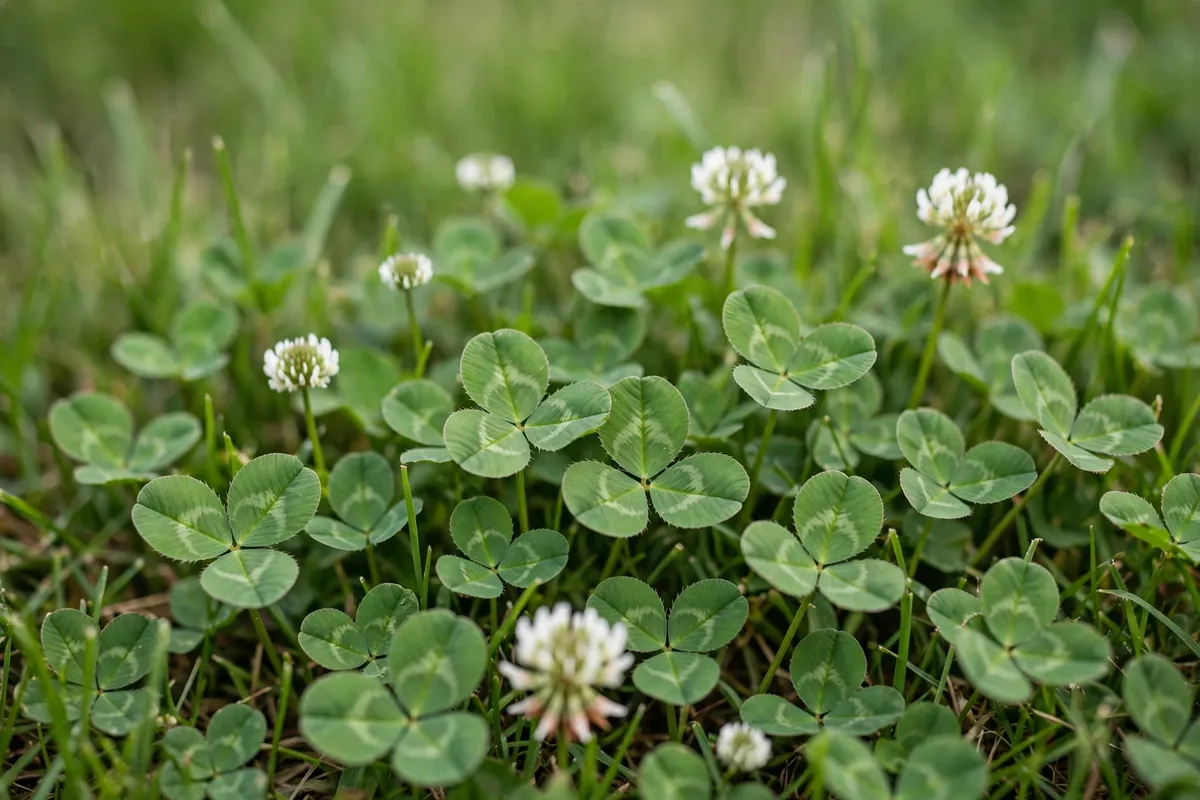
| White clover | Three round leaflets, white (sometimes pinkish) round flowers, spreads by creeping stolons that root at the joints | True clover — this guide applies |
| Red clover | Taller, upright growth, larger leaflets, pink-purple flowers | True clover — this guide applies |
| Black medic | Yellow flowers, leaflets with a pointed tip, small black seed pods | NOT clover — different treatment response; check local extension guidance |
| Oxalis (wood sorrel) | Heart-shaped leaflets that fold at night, yellow or pink flowers | NOT clover — spreads aggressively by seed; different approach |
If it has three round leaflets, white flowers, and ground-hugging stems that root as they creep — that’s white clover, and the methods below are for you.
The Removal Methods (In Order of Scale)
Start at the top for small patches; move down the list as the infestation grows.
1. Hand-Pull Small Patches
For new or small infestations, pulling is free, precise, and chemical-free — with one critical detail: get the stolons. White clover spreads by creeping horizontal stems (stolons) that root at every joint. Yanking the leaves off while leaving rooted stolon fragments in the soil just creates two clover plants where there was one.
- Water first — moist soil releases the shallow root system intact.
- Work outward from the center of the patch, tracing and lifting the stolons.
- Bag the pulled material; don’t leave fragments on the lawn.
2. Fix the Nitrogen (The Real Cure)
This is what actually keeps clover gone. Everything else is removal; this is prevention:
- Get a soil test. It tells you exactly what your soil is missing instead of guessing. Your local extension service does them cheaply.
- Feed the lawn properly. Follow the test results — typically nitrogen in spring and fall for cool-season grasses. Well-fed grass grows thick enough to outcompete clover seedlings.
- Mow high — 3 inches or more. Taller grass shades clover and favors turf growth. Short mowing favors the clover.
- Overseed thin areas in fall. Fill the bare gaps where clover colonized — see our guide to overseeding a lawn without aerating.
Safety note: whenever herbicides come up below, read and follow the product label exactly — rates, timing, protective equipment, and keep-off periods for kids and pets. The label is the law; this guide is the strategy.
Since clover thrives where nitrogen is low, use UC IPM’s lawn weed management guide to build a healthier lawn.
3. Spot-Treat With Selective Broadleaf Herbicide
For established patches where pulling isn’t practical, a selective broadleaf herbicide targets clover without killing established lawn grass — when used exactly as the label directs.
- Apply when clover is actively growing — spring or fall, NOT summer. Heat-stressed lawns don’t absorb treatment well, and you’ll injure the grass trying.
- Clover’s waxy leaves resist spray. This is normal and expected — plan on a second application 2–3 weeks later for full control. One pass rarely finishes the job.
- Spot-treat the patches, don’t blanket-spray the whole lawn. Targeted treatment, targeted results.
- Look for products listing a clover-effective broadleaf active ingredient (the triclopyr or 2,4-D type — check the active-ingredients panel, not the brand name). No brand endorsements here; the ingredient type is what matters.
4. Smother Dense Patches
For areas that are 90% clover and 10% grass, fighting plant by plant is the slow road. The faster reset: smother it. Cover the area with a tarp or thick cardboard for several weeks until everything underneath dies, then rake out, amend, and reseed. It’s scorched-earth, but for a fully colonized patch it’s faster than a season of spot treatments — and you control what goes back in.
For non-chemical control options, see UC IPM’s clover guide.
What NOT to Do
- Don’t use non-selective weed killer on the lawn. It kills the grass along with the clover, leaving bare soil — the exact conditions clover loves. Non-selective products are for driveways and fence lines, never turf.
- Don’t pull and leave stolon fragments behind. Every rooted fragment is a new plant. Trace the creeping stems and get them whole.
- Don’t skip the feeding step. Kill every clover plant in the yard and skip the nitrogen, and the clover is back by next spring — wider than before. The nitrogen fix isn’t optional; it’s the whole point.
The Other Option — Should You Just Keep the Clover?
Here’s the honest question nobody in the removal business asks: is clover actually bad?
Clover lawns — and especially modern microclover blends — are a legitimate lawn choice: drought-tolerant, pollinator-friendly, self-fertilizing, and they need no fertilizer at all. They stay green in summer heat when surrounding grass goes dormant, and bees love the flowers. Clover is only a “weed” if what you want is uniform grass.
This guide exists for homeowners who want the clover gone. But if you’d rather join it than fight it, our companion guide to microclover lawns covers how to grow and maintain a clover lawn on purpose. Both choices are valid — this page and that one are the pair: fighting it? You’re in the right place. Joining it? That’s the guide.
Frequently Asked Questions
What kills clover but not grass?
Selective broadleaf herbicides target clover without harming established lawn grass when used exactly as the label directs. For small patches, hand-pulling (getting all the stolons) works with zero chemicals.
Why is clover taking over my lawn?
Because your lawn is nitrogen-starved. Clover fixes its own nitrogen from the air, so it thrives where hungry grass struggles. A soil test and proper feeding fix the root cause.
Will mowing kill clover?
No — clover grows low and spreads by ground-hugging stolons that mowing misses. But mowing HIGH (3″+) helps grass shade it out over time.
Does clover come back every year?
White clover is perennial — it survives winter and spreads wider each year. Without fixing the underlying nitrogen deficiency, yes, it comes back worse every spring.
Is clover bad for your lawn?
Not necessarily — it’s a legitimate lawn alternative (drought-tolerant, feeds pollinators, needs no fertilizer). It’s only a “weed” if you want uniform grass. Our microclover guide covers the pro-clover case.
When is the best time to treat clover?
Spring and fall, when clover is actively growing and temperatures are moderate. Summer heat-stressed lawns don’t absorb treatment well, and you’ll injure the grass.
(Keeping the rest of the lawn healthy while you fight weeds: our guide to how often to water your lawn keeps your watering on track, and if dandelions are the other invader in the yard, see our natural-methods guide to getting rid of dandelions. For the seasonal weed calendar, the crabgrass battle plan pairs with this guide.)