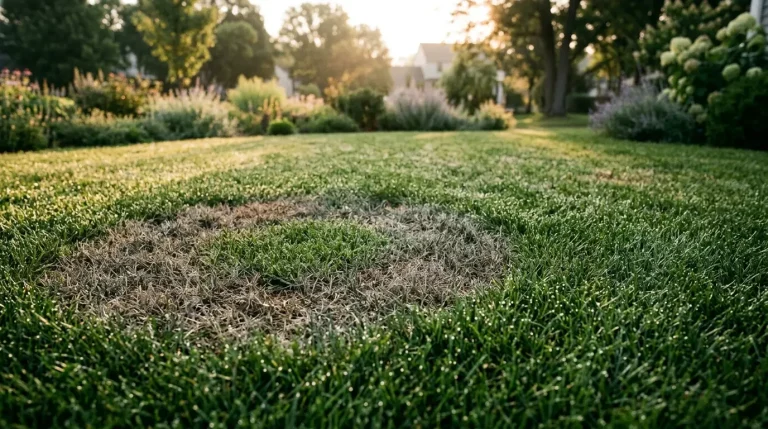
Why Is Your Grass Turning Yellow in Patches?
Yellow patches are a symptom, not a disease. The same yellow spot could be dog urine, fungus, grubs, or a nutrient problem — and each demands a completely different fix. Treat fungus when the real problem is grubs and you’ve wasted a month.
The good news: the pattern of the yellowing is the diagnosis. Different causes make differently shaped, differently behaving patches. Match your symptom in the table below, confirm with the hands-on tests, and you’ll know exactly what you’re dealing with.
Match Your Symptom — The Pattern Table
| What you see | Likely cause | Confirm with |
|---|---|---|
| Small round spots with a dark-green ring around each one | Dog urine (nitrogen burn) | Spots appear where dogs go; center dead, ring lush |
| Circular patches, yellow/brown, expanding outward over days | Fungal disease (brown patch / dollar spot) | Check in humid weather; look for lesions on blades |
| Irregular patches where grass pulls up easily like loose carpet | Grubs (beetle larvae eating roots) | The tug test — see Cause 3 |
| Uniform pale yellowing across areas rather than distinct spots | Nitrogen deficiency | Whole areas pale, not spotty; slow growth |
| Yellowing between the leaf veins, newest growth hit first | Iron deficiency | Veins stay green, tissue between turns yellow |
| Yellow-brown along mower lines or high spots | Dull-blade tearing or heat/drought stress | Tips frayed (blade) or footprints stay visible (drought) |
Work through the causes below in the order that matches your pattern. Start with the hands-on tests — they take minutes and they’re definitive.
Cause 1 — Dog Urine Spots
The classic: small round dead spots, each surrounded by a suspiciously lush dark-green ring. It looks almost deliberate — because chemically, it is.
Dog urine is concentrated nitrogen. In the center of the spot, the nitrogen dose is so high it burns the grass (fertilizer burn). Around the edges, the diluted dose is exactly what grass wants — hence the dark-green ring of thriving grass circling each dead center. Female dogs tend to cause worse spots (they empty the bladder in one place); male dogs’ marking is more diffuse.
The fix: dilution is everything. If you catch it happening, soak the spot with water immediately — a gallon poured over the area dilutes the nitrogen below burn level. Train the habit: keep a watering can by the door. For existing dead spots, rake out the dead grass, loosen the soil, and reseed in fall — the surrounding ring will fill in on its own. Long-term, encourage the dog toward a mulch or gravel area, or rotate potty spots so no single area takes repeated hits.
Cause 2 — Fungal Disease
If the patches are roughly circular, yellow-to-brown, and expanding outward over days — especially in warm, humid weather — you’re likely looking at fungus. The two most common culprits:
- Brown patch: large circular patches (up to several feet), often with a darker “smoke ring” at the active outer edge. Thrives in heat + humidity + excess nitrogen.
- Dollar spot: smaller patches (silver-dollar sized, hence the name), bleached straw-colored, often with cobweb-like mycelium visible on dewy mornings.
Confirm it: go out early in the morning when dew is on the grass. Fungal patches often show fine webby growth, and individual blades have distinct lesions (spots with dark borders). Patches that grow visibly larger over a week are almost certainly fungal — dog spots and grubs don’t expand in neat circles.
Treatment: improve the conditions first — water deeply but infrequently in the morning (never evening; wet grass overnight is a fungal paradise), improve airflow by pruning overhanging plants, and avoid excess nitrogen fertilizer in summer. For active infections, see our guide to the best lawn fungus treatments, plus the specific ID guides for brown patch and dollar spot.
Cause 3 — Grubs
Grubs — the white C-shaped larvae of beetles — eat grass roots. The above-ground symptom: irregular yellow patches that, distinctively, pull up like loose carpet because there’s nothing holding the grass down anymore.
The tug test (definitive, takes 30 seconds): grab a handful of grass at the edge of a yellow patch and pull firmly. Healthy grass resists. Grub-damaged turf lifts right up, revealing chewed-off roots and (if you look) the white grubs themselves in the top inch of soil. No tug test failure, no grubs — it’s that reliable.
Timing: grub damage shows up in late summer to early fall, when the larvae are large and feeding aggressively. If you’re seeing carpet-like patches in August/September, grubs jump to the top of the suspect list. Treatment timing matters enormously — preventive products go down in early summer before eggs hatch; curative treatment of active grubs is a narrower window. And grubs attract their own secondary symptom: skunks and raccoons tearing up the lawn at night to eat them. If wildlife is excavating your yellow patches, that’s practically a grub confession.
Cause 4 — Nutrient Deficiency
Not every yellow patch is a pest or disease. Sometimes the lawn is just hungry — and the pattern of hunger tells you what’s missing:
- Nitrogen deficiency: uniform pale yellowing across broad areas (not distinct spots), slow growth, thin turf. The whole lawn looks washed-out rather than patchy. This is the most common deficiency and the easiest to fix — but confirm with a soil test before fertilizing blindly, because excess nitrogen feeds fungal disease (see Cause 2).
- Iron deficiency: distinctive yellowing between the leaf veins while the veins themselves stay green, hitting the newest growth first. Common in alkaline soils where iron is present but locked up and unavailable to the plant. Iron corrects fast (days, not weeks) once addressed.
The soil test rule: if you’re considering fertilizing to fix yellowing, spend the small fee on a soil test first through your local extension service. Guessing wrong wastes money and can make fungal problems worse. Your neighbor’s lawn might just be better fed — see why is my neighbor’s lawn greener than mine for the full comparison.
Cause 5 — Heat/Drought Stress and Dull-Blade Tearing
The quick rule-outs — check these before assuming anything exotic:
- Heat/drought stress: grass under drought stress turns yellowish and your footprints stay visible long after you walk across it (the blades lack the turgor to spring back). High spots and areas near pavement go first. Deep, infrequent watering fixes it — see how often to water your lawn for the right schedule.
- Dull-blade tearing: if the yellow appears as a general cast along your mowing lines a day or two after cutting, inspect the blade tips. Torn, frayed tips (rather than clean cuts) turn brown-yellow and make the whole lawn look sickly. Sharpen the blade and the “disease” vanishes.
The Fix Order — What to Do This Weekend
Don’t treat anything until you’ve diagnosed. In order:
- Tug test every yellow patch (30 seconds each). Carpet-lift = grubs; move to grub treatment timing.
- Check the pattern against the table above. Dog-ring pattern? Fungal circles? Uniform paleness?
- Rule out the simple stuff: recent dog activity, watering schedule (footprint test), blade sharpness.
- Treat the matched cause — and only that cause. Fungus gets airflow/watering changes and treatment; grubs get timed treatment; urine spots get dilution and reseeding; deficiencies get a soil test first.
- Reseed the bare spots in fall. Whatever killed the patches, thick turf is what keeps them from coming back.
Frequently Asked Questions
Why is my grass turning yellow in patches but not the whole lawn?
Because the cause is localized, not lawn-wide. Patchy yellowing points to dog urine spots, fungal disease, grubs, or uneven watering — a nutrient deficiency or watering problem would typically affect broad areas uniformly. Use the pattern table above to match your symptom.
How do I know if yellow patches are grubs or fungus?
The tug test settles it: grab the grass at the patch edge and pull. If it lifts like loose carpet with chewed roots (and you may see white grubs in the soil), it’s grubs. If the grass is firmly rooted but the patches are circular and expanding outward — especially in humid weather — it’s fungal.
Will yellow grass turn green again?
Often, yes. Drought/heat stress and mild nutrient deficiencies recover once corrected — sometimes within days. Grub-killed areas and urine-burned centers are dead and won’t recover; those spots need raking out and reseeding.
Does dog urine really kill grass?
Yes. It’s concentrated nitrogen — the center of the spot gets a burn-level dose (dead brown center) while the diluted edges get a fertilizer-level dose (the telltale dark-green ring). Diluting with water immediately after is the most effective prevention.
What deficiency causes yellow patches in grass?
Usually nitrogen — showing as uniform pale yellowing and slow growth across areas. Iron deficiency is more distinctive: yellowing between the leaf veins with the veins staying green, on the newest growth first. Get a soil test before fertilizing to confirm which one you’re dealing with.
Should I water yellow patches more?
Only if drought is actually the cause (footprints stay visible on the lawn). Overwatering makes fungal yellowing worse — and fungus is one of the most common causes of yellow patches. Diagnose first, then water accordingly: deep and infrequent in the morning for drought, and back off the evening watering if fungus is suspected.