Snowblower Leaking Gas? Find the Leak in 5 Minutes
It’s October. You wheel the snowblower out for its pre-season check, fill the tank — and the smell of gasoline hits you. Or you spot drips on the floor. Either way, take it seriously: a fuel leak isn’t just a nuisance. Gasoline dripping near a hot engine or muffler is a fire hazard — fix-it-now, not run-it-anyway.
The good news: fuel leaks come from a short list of usual suspects, and finding the exact spot takes about five minutes of looking. Here are the four locations in likelihood order — safety rules first.
Safety First — Read This Before Touching Anything
- No open flames, no smoking, no sparks near the machine.
- Never run the engine to “see where it drips.” The most important rule here: a running engine means a hot muffler, and gas on a hot muffler means fire. Find leaks with the engine OFF and cold, by looking — not by running it.
- Work outdoors or ventilated — garage doors fully open at minimum.
- Shut off the fuel valve before inspecting.
- Wipe up spills immediately; dispose of gas-soaked rags properly (spread outdoors to dry or bag for disposal — never a pile in the garage).
- Let the engine cool completely if it was recently run.
If fuel is pouring rather than dripping: drain the tank into an approved container first, then
diagnose.
Because spilled fuel is a leading cause of garage fires, follow Mississippi State’s gasoline safety precautions when handling and storing gasoline.
Find the Leak — The 4 Leak Locations
Fill the tank, leave the engine off, and trace from the tank down to the carburetor. Fuel flows downhill, so the highest wet spot is usually the source.
1. Cracked or Loose Fuel Line
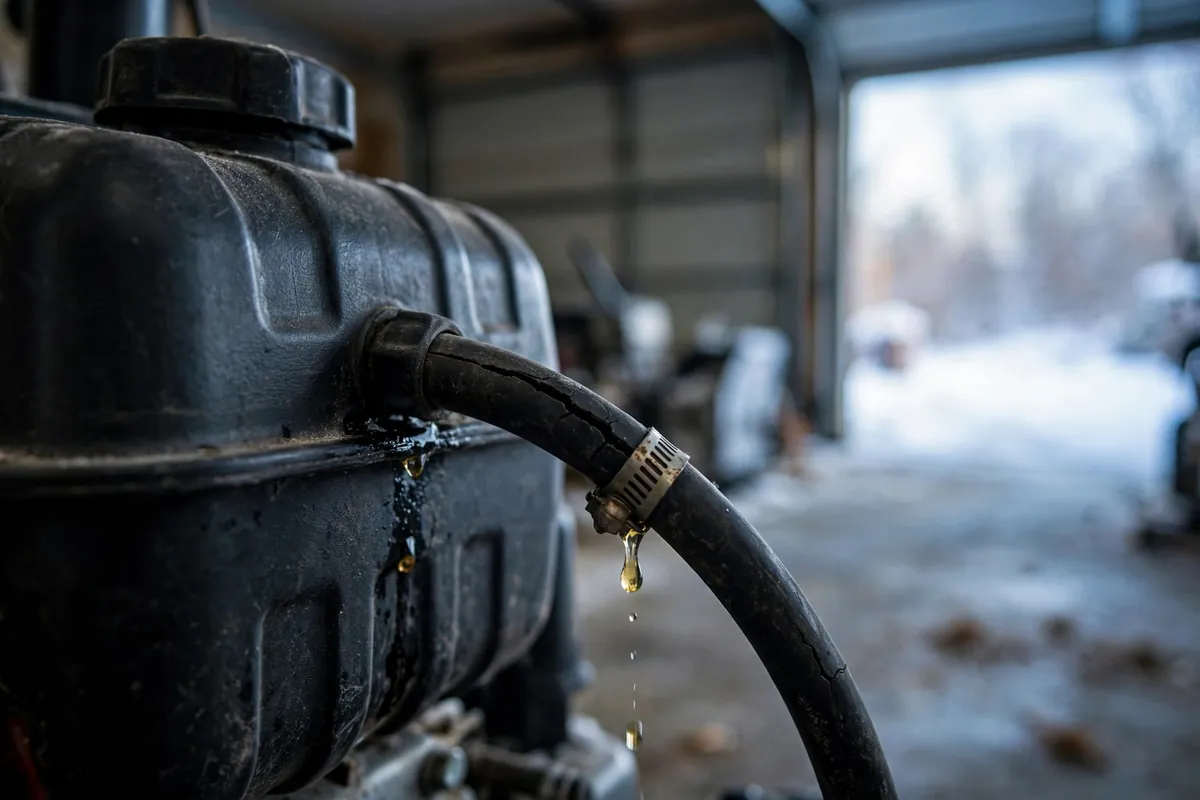
The #1 cause. Modern fuel contains ethanol, which dries out rubber fuel lines — especially lines that sit all summer. The rubber hardens, cracks, and leaks the moment you fill up in fall.
Where to look: both ends of the line (tank outlet and carburetor inlet) and anywhere it bends or rubs the frame.
The squeeze test: pinch the line gently. Healthy line is flexible and rubbery; stiff, brittle, or visibly cracked = replace it. A cracked line can’t be patched. Also check that the line is fully seated on its fittings — dried line can shrink and pull loose at the barb.
2. Carburetor Bowl Gasket
Gas dripping from the bottom of the carburetor = the bowl gasket. The float bowl hangs at the carb’s base; its gasket dries out over summer storage, shrinks, and weeps fuel around the bowl’s edge.
Confirm it: dry the carb thoroughly with a rag, then watch. Fuel reappearing at the bowl-to-body seam = gasket failure. Remove the bowl (usually one bolt), replace the gasket, and inspect the bowl for pinhole corrosion — a new gasket won’t fix a holed bowl. Clean varnish from the bowl while you’re in there.
3. Stuck Float / Needle Valve
Gas overflowing from the carburetor throat — especially when priming — means the float needle isn’t sealing. Varnish from old fuel makes the needle stick; the bowl overfills and fuel spills out.
The tap test: with the fuel valve on, tap the bowl firmly with a screwdriver handle. If the overflow stops, you’ve confirmed a sticking needle — clean or replace the needle and seat anyway, because it will stick again.
Critical follow-up: overflowed fuel can drain past the rings into the crankcase. Check your oil — if the dipstick smells like gasoline or the level is mysteriously high, change the oil before running the engine. Fuel-thinned oil destroys lubrication.
4. Cracked Primer Bulb or Fuel Tank
The primer bulb is rubber, it ages, it gets brittle — visible cracks mean it’s leaking (worst when pressed, since priming pressurizes it). Replace a cracked bulb as a unit; disintegrating rubber can’t be patched.
The fuel tank can crack at seams or mounting points as plastic ages. Inspect with a flashlight for wet seams or hairline cracks. A tank leak means tank replacement — the biggest job on this list.
“Leaks Only When Priming” — The Special Case
No leak at rest, but fuel appears every time you press the primer? Priming pressurizes the fuel system, forcing fuel through a weak spot that doesn’t leak under gravity: usually a worn needle valve or a cracked primer bulb. It’s an overflow symptom, not a separate root cause — fix the weak needle or bulb and the priming leak stops.
If the machine is also running rough, the fuel system has broader problems (varnish, partial clogs) — see why your snow blower is surging, since fuel-system issues cause both.
The Repair Rules
- Replace fuel lines whole — never splice. A splice is a future leak and a fire risk. One continuous piece of hose, fitting to fitting.
- Use fuel-rated hose — rated for gasoline/ethanol, not just any rubber hose.
- Drain the tank before opening the fuel system. Don’t pull a bowl or line with a full tank above it.
- Check for fuel in the oil after any carb overflow. Gas smell on the dipstick = change the oil.
Prevention — Why Leaks Happen After Summer Storage
Nearly every fall fuel leak has the same origin: the machine sat all summer with ethanol fuel in the system. Ethanol dries out every rubber component it touches over months of sitting — then everything weeps at once when you fill up in October.
Storage discipline prevents it: run it dry before summer (shut the fuel valve, let the engine die burning the carb clean) or stabilize the fuel (stabilizer in a full tank, run a few minutes so treated fuel reaches the carb).
While you’re prepping for the season, check the rest of the machine too: snowblower not throwing snow far for the discharge tune-up, how to prevent snow from sticking to your snowblower for mid-season performance, and how to change a belt on a snowblower if the belt is due. Pushing snow instead of clearing it? See why your snow blower is pushing snow.
Many leaks trace back to neglected off-season maintenance, so compare your routine against the University of Georgia’s small-engine maintenance guide.
Frequently Asked Questions
Why is my snowblower leaking gas?
The most common causes, in order: a cracked fuel line (ethanol dries rubber over summer storage), a dried-out carburetor bowl gasket, a stuck float needle letting fuel overflow, or a cracked primer bulb. Work through the four locations in order — the highest wet spot on the fuel path is usually the source.
Is it safe to run a snowblower that’s leaking gas?
No. Gasoline dripping near a hot engine or muffler is a fire hazard. Find and fix the leak first — most are a single inexpensive part (fuel line, gasket, primer bulb) and a short repair.
Why does my snowblower leak gas when I prime it?
Priming pressurizes the fuel system, forcing fuel through a weak spot that doesn’t leak under gravity — usually a worn needle valve or cracked primer bulb. The priming leak is the symptom; fix the weak needle or bulb and it stops.
Can old gas cause a snowblower to leak?
Indirectly, yes. Ethanol fuel sitting all summer dries out rubber fuel lines, gaskets, and primer bulbs, which crack and leak when you fill up in fall. Run the carb dry or stabilize the fuel before storage to prevent it.
Should I repair or replace a cracked fuel line?
Replace the whole line with new fuel-rated hose. Patching or splicing is unsafe and won’t hold — run one continuous piece from fitting to fitting.