Riding Mower Battery Keeps Dying? Fix the Drain
You charge it. You mow the whole yard. You park the mower feeling accomplished. Next weekend — dead. Again. Jump-start it, mow again, dead again. And “just buy a new battery” isn’t the answer, because if the mower is killing batteries, a new one dies the same way.
The battery is usually the victim, not the criminal: something is failing to recharge it, draining it, or it’s simply too old to hold a charge. Here are the four real causes in likelihood order — with exact multimeter numbers — so you find the actual problem instead of buying parts at random.
Quick Triage — Which Battery Problem Do You Have?
“Battery problem” covers three different situations, and each has a different fix:
| Your symptom | What’s happening | Where to look |
|---|---|---|
| Key turns, you hear clicks, engine never cranks | Won’t crank at all — starter circuit issue | Riding mower clicks but won’t start — a different problem with a different diagnosis |
| Engine starts (or jump-starts) fine, runs, but the battery is dead again next time | Starts but won’t stay charged — charging system or parasitic drain | This article — keep reading |
| Brand-new battery is dead or dies almost immediately | New-battery charging question | Does a new lawn mower battery require charging? |
Won’t crank at all? That’s a different article. Starts and runs but the charge never lasts? You’re in the right place.
The 4 Causes, in Likelihood Order
1. Dead Battery Cells (The 3-Year Rule)
The most common cause is the simplest: the battery is worn out. Most riding-mower batteries last 3–4 years. Past that, the plates sulfate, cells weaken, and the battery physically cannot hold a charge. If yours is older than 4 years and won’t stay charged, stop diagnosing — age alone is the answer.
The trap that wastes everyone’s time: a voltmeter reading of 12.6V at rest means nothing. A dying battery can show full resting voltage and collapse the moment it has to do real work. The only test that matters is voltage under load: connect the multimeter, have someone turn the key, and watch. Above 9.6V while cranking = healthy. Collapse to 8V or below = dead cells.
Before replacing it, confirm it’s actually dead and not just neglected — our guide to how to restore a lawn mower battery covers testing, charging, and revival techniques.
2. The Charging System Isn’t Recharging While You Mow (Stator)
Your mower is supposed to charge its own battery. The stator — coils under the flywheel — generates electricity whenever the engine runs at full throttle, and the regulator feeds it back to the battery. If the stator fails, the mower runs fine off the battery and slowly drains it dry during the mow. You park it, and there’s nothing left next weekend.
The stator output test: engine at full throttle (blades engaged if possible), measure across the battery terminals. You should see 13.5–14.5V. Stuck at 12.6V or dropping = the charging system isn’t charging: stator or diode issue. Two caveats: test at full throttle, not idle (stator output depends on engine speed), and test with a battery that can accept charge — dead cells (cause #1) skew this reading, so rule the battery out first. Corroded terminals can also fake a stator failure, so clean them (below) before condemning the stator.
3. Failed Voltage Regulator
The voltage regulator sits between the stator and the battery, taming raw stator output into a steady charge. It fails two ways:
- Never charges: battery drains during mowing even though the stator tests good — the regulator isn’t passing current through.
- Overcharges: battery gets hot, case bulges, electrolyte boils off. Unregulated voltage destroys a battery in weeks.
How to test: measure the regulator’s output toward the battery at full throttle — steady 13.5–14.5V is healthy; no output (or wild unregulated voltage) means it’s failed. Diagnose the stator first (cause #2): a bad regulator is what you conclude when stator output exists but nothing reaches the battery.
4. Parasitic Drain (Dead Overnight)
A parasitic drain is something drawing current with the key off — a stuck relay, shorted switch, corroded wire, or an internally shorted solenoid. The mower runs and charges fine; parked, it silently bleeds the battery dead.
The test-light-in-series test:
- Key OFF, removed. Disconnect the negative battery cable.
- Connect a 12V test light between the cable end and the negative terminal, bridging the gap.
- Any glow = current flowing with the key off. A healthy mower draws nothing.
- Pull fuses one by one. When the light goes out, you’ve found the circuit. Trace it: relay, switch, wiring, component.
A bad solenoid is a classic drain source — a stuck or shorted solenoid draws current continuously. See can a bad solenoid drain your battery for the solenoid-specific test. But check relays and wiring too; the fuse-pull method finds whichever circuit it is.
The Multimeter Walkthrough (10 Minutes)
Set the meter to DC volts (20V range). Red probe to positive, black to negative. Three numbers:
- Rest voltage (engine off, sitting an hour): ~12.6V = full. 12.0V ≈ half. Below 11.8V = effectively dead. If it reads 12.6V today and 11.5V tomorrow morning, you have a drain or dead cells.
- Cranking voltage (watch while someone turns the key): should stay above 9.6V. Collapse below 8V = the battery can’t deliver current — dead cells.
- Charging voltage (full throttle, blades engaged): 13.5–14.5V. Present = charging system works (suspect battery or drain). Stuck at 12.6V or lower = stator or regulator failure.
Write these on tape inside the battery compartment: 12.6 / 9.6 / 13.5–14.5. Every battery diagnosis comes back to these numbers.
Beginner safety: batteries vent hydrogen gas. Work in ventilation, keep sparks away from the battery top, wear eye protection, and disconnect the spark plug wire so the engine can’t fire while testing.
Terminals and Cables — The 5-Minute Fix People Skip
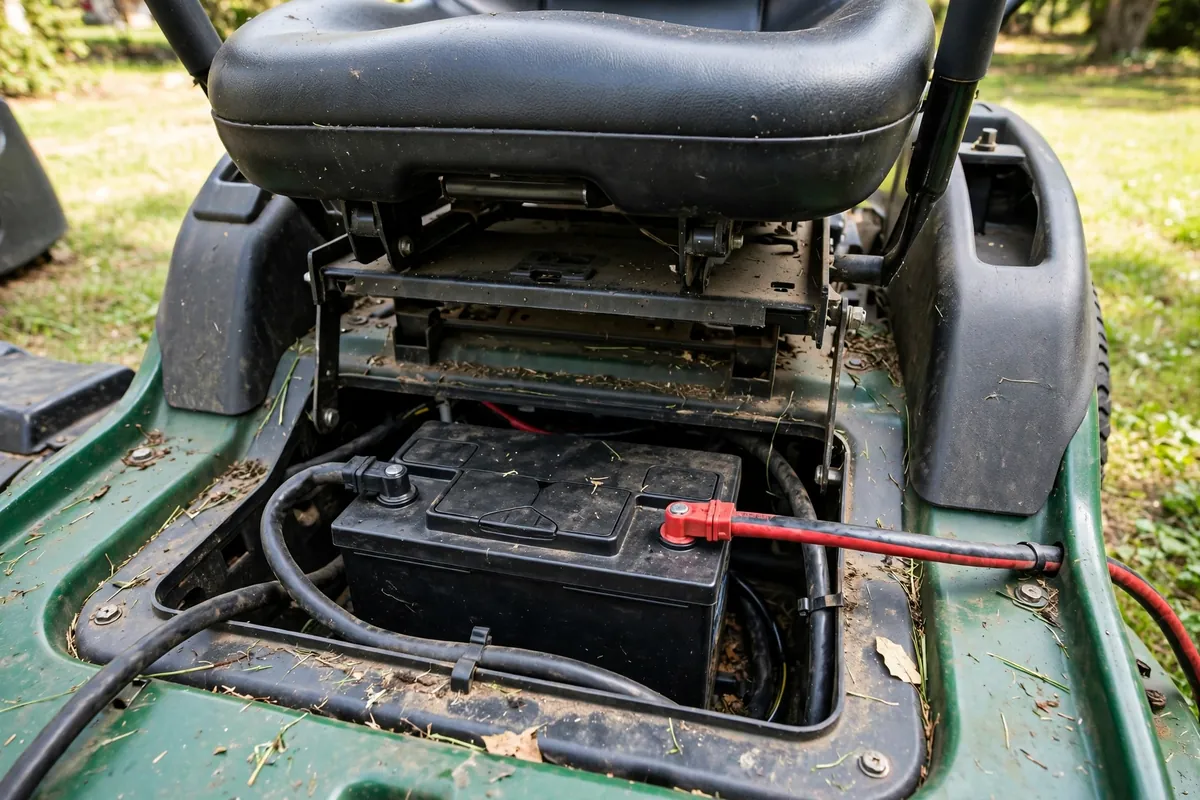
Corrosion is resistance. A green-white crust on the terminals can block both discharge and charging current — mimicking a dead battery and a failed stator at once.
Clean-and-tighten: disconnect negative first, then positive. Scrub terminals and cable ends with a wire brush (baking-soda solution first if the crust is heavy) until you see bright metal. Reconnect positive first, then negative; tighten firmly — no twisting the cable end by hand. Coat with dielectric grease or petroleum jelly.
Also check cable-to-component connections, not just the battery posts: corroded solenoid connections mimic battery failure the same way.
Winter Storage Kills Batteries
Batteries self-discharge sitting idle, and months discharged over winter sulfate the plates permanently. The battery that “was fine in October” is dead by April because winter killed it slowly.
Prevention: remove the battery and keep it on a battery maintainer (a low-amp trickle device that holds full charge — different from a regular charger) over winter, or charge it monthly. See
For safe charging and winter storage, review this lead-acid battery safety guidance from UC Riverside.
lawn mower battery care during the winter season for the full seasonal routine.
Related electrical gremlin: if your mower starts fine but dies when you engage the blades, that’s a different fault in the same cluster — see why your riding mower dies when blades are engaged.
Frequently Asked Questions
Why does my riding mower battery keep dying?
The four causes in likelihood order: worn-out battery cells (most last 3–4 years), a charging system that isn’t recharging while you mow (stator), a failed voltage regulator, or a parasitic drain pulling current with the key off. Test the battery under load first, then charging voltage at full throttle, then hunt for a drain.
How do I know if it’s the battery or the charging system?
Charge the battery fully, then test in two steps. First: does it hold charge sitting disconnected? If yes, the battery is fine and the mower is the problem. Second: at full throttle, measure across the terminals — 13.5–14.5V means the charging system works; stuck at 12.6V or below points to the stator or regulator.
Can a bad solenoid drain a riding mower battery?
Yes — a stuck or internally shorted solenoid can draw current continuously with the key off. See our solenoid guide for the solenoid-specific test. But check relays, switches, and wiring too — the test-light-in-series method with the fuse-pull walkthrough finds the exact circuit.
Should a riding mower charge its own battery?
Yes. The stator under the flywheel generates electricity while the engine runs, and the voltage regulator feeds it back to the battery. If the battery doesn’t hold charge through a mowing session, the charging system is failing, not the battery.
How long do riding mower batteries last?
Typically 3–4 years. Older than that and won’t hold a charge? Age alone is the likely cause — no deeper diagnosis needed. Winter storage without a maintainer shortens that lifespan significantly.
Can I use a car charger on my riding mower battery?
A low-amp trickle charger or maintainer is fine. A high-amp car charger can overheat and damage a small mower battery — never exceed the battery’s rated charge current (check the battery label). Slower and longer beats faster.
Won’t crank at all — just clicks when you turn the key? That’s the other half of the electrical cluster: start with riding mower clicks but won’t start to diagnose the starter circuit.