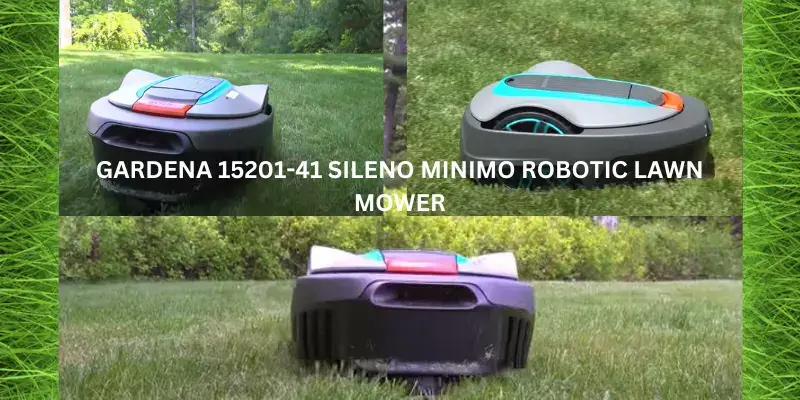
Gardena Sileno Minimo Robotic Lawn Mower: Features and Specs
The Gardena Sileno Minimo is one of the smaller robotic mowers on the market, aimed at compact town gardens rather than sprawling lawns. It is a boundary-wire machine with Bluetooth control, and its defining characteristic is how quiet it is — quiet enough that most owners genuinely cannot hear it working from indoors.
This is a look at what the Minimo does, what it does not do, and the kind of garden it fits. If you are still deciding whether a robot suits your lawn at all, start with our broader guide to robotic lawn mowers and come back to the specifics.
How the Sileno Minimo works
Like most robots in this class, the Minimo navigates by boundary wire. A low-voltage cable is pegged around the perimeter and around any beds or ponds you want excluded; the mower senses the field and turns away from it. Within that boundary it moves in a pseudo-random pattern, covering the lawn through sheer repetition rather than mowing in lines.
It cuts a small amount every day and returns to its charging station on its own when the battery runs low. There is no grass box — the clippings are short enough to fall into the sward and break down, which is continuous mulching and feeds the soil as it goes.
The features that matter
Genuinely quiet operation
Gardena rates the Minimo at around 57 dB. For context, a petrol mower runs at 95 dB or more and a battery push mower around 80 dB. At 57 dB you are in the range of ordinary conversation, which is what makes early-morning or evening mowing practical in a garden with close neighbours.
Slopes up to 35%
Thirty-five percent works out at roughly 19 degrees — a noticeable bank rather than a gentle roll. That rating assumes dry grass; traction drops on wet ground, as it does on every robot. For a garden with a real slope to it, treat the figure as a ceiling rather than a working target.
All-weather operation
The Minimo keeps mowing in rain rather than retreating to base. That covers more ground over a wet week, at the cost of more wet clippings packed under the deck. Plan on brushing the underside out more often than you would with a rain-sensing model.
Bluetooth app control
Scheduling, cutting height and start/stop are handled through Gardena’s phone app. Being Bluetooth rather than Wi-Fi, you need to be within range of the mower to change anything — fine in a small garden, less convenient if you want to adjust the schedule while away from home.
Quick charging
A 60–75 minute charge cycle is short for this class. On a robot the charge-to-mow ratio matters more than raw battery size, because the machine manages its own cycles — a shorter charge simply means more mowing passes per day.
Specifications
- Cutting width: 6.2 inches (16 cm)
- Dimensions: 20.4 × 13.4 × 8.7 inches
- Battery: lithium-ion, included
- Charging time: 60–75 minutes
- Maximum slope: 35% (19 degrees)
- Noise level: approximately 57 dB
- Navigation: boundary wire with guide cable
- Connectivity: Bluetooth
- Clipping handling: mulching only, no collection
The 6.2-inch cutting width is the number to pay attention to. It is narrow, which is what keeps the machine small and quiet, but it also means the Minimo needs more passes to cover a given area than a wider robot. This is a mower for a compact lawn, and pushing it onto a large one is the most common way to be disappointed by it.
Strengths
- Among the quietest mowers of any type at roughly 57 dB
- Weather-sealed and happy to work through rain
- Handles slopes up to 35%, which is respectable for a machine this size
- Short 60–75 minute charge cycle
- Simple Bluetooth scheduling without a subscription or account
- Small and light enough to lift and store easily over winter
Limitations
- No GPS or Wi-Fi. No remote control from outside Bluetooth range, and no satellite-assisted navigation or tracking.
- No obstacle detection beyond contact. The mower finds objects by bumping into them rather than sensing them in advance.
- Boundary wire installation. Expect to spend an afternoon laying and pegging cable, and to redo sections if you change your borders.
- Narrow cutting width. Fine on a small lawn, slow on anything approaching the top of its rated area.
- Random mowing pattern. No systematic lines, and therefore no stripes.
None of these are faults so much as the consequences of building a small, quiet, affordable robot. They only become problems if you buy it for a garden it was not designed for.
Setting it up
Installation is where robotic mowers succeed or fail, and the Minimo is no exception. The base station needs level ground, mains power and a clear run-in. The boundary wire has to sit at the correct distance from hard edges — too close and the mower clips paving, too far and you are left trimming an uncut strip by hand. The guide cable needs laying so the machine can find its way home from the furthest corner.
Follow the spacing figures in the manual rather than estimating them. Our step-by-step walkthrough covers the process in detail: how to install and set up your robotic lawn mower.
One thing to do first: cut the lawn conventionally down to the height you want the robot to maintain. A robotic mower maintains a lawn, it cannot reclaim one. An electric push mower is fine for that initial cut.
Living with it
The blades are small consumable discs and want replacing every one to three months — they are inexpensive, and a blunt set shows up as a ragged lawn faster than you would expect. Brush the underside and wheel arches out regularly, and keep the charging contacts clean, since a poor contact presents exactly like a battery fault.
Over winter, bring the mower indoors, leave the battery at roughly half charge and store it somewhere frost-free. The same principles as winter battery care apply.
And like every robot, it will not cut a clean edge against a wall or fence. Budget for trimming the perimeter every few weeks, or lay a flush mowing strip the machine can run over.
Who it suits
The Sileno Minimo makes sense for a small, reasonably simple town lawn where noise matters and the owner wants to stop mowing altogether. Its quietness and compact size are real advantages in exactly that setting.
It is the wrong machine for a large or complex garden, for anyone who wants app control from away from home, or for anyone whose lawn is defined by its stripes — that finish comes from a cylinder mower and nothing else. Match it to the garden it was built for and it does that job quietly and well.