Why Your Lawn Mower Vibrates So Much
Every mower vibrates a little — that’s just an engine doing its job. But when the shaking crosses from normal buzz into rattling, shuddering, teeth-chattering territory, something is wrong. And here’s the part that matters: abnormal vibration can mean a blade is about to come loose or a shaft is bent, both of which can turn dangerous fast.
Stop First — The Safety Rule
If your mower suddenly starts shaking violently mid-mow: stop mowing immediately. Shut the engine off, disconnect the spark plug wire, and inspect before you restart. Vibration severe enough to notice is vibration severe enough to shear a blade bolt or throw a blade — and a blade departing at 3,000 RPM is genuinely dangerous. Never try to “mow through it and see if it settles.” Diagnose first, mow second. Every check below starts with the engine off and the plug wire disconnected.
The 5 Causes, in Likelihood Order
1. Unbalanced or Damaged Blade
The most common cause, by far. Mower blades spin at around 3,000 RPM — at that speed, even a small imbalance becomes a violent shake. It usually starts the moment you hit something: a rock, a root, a stump, a piece of buried metal. The impact bends the blade slightly, chips off a chunk, or curls the cutting edge — and from that second on, the blade is out of balance.
How to check: engine off, plug wire disconnected, tilt the mower (air filter side up so oil doesn’t flood it) and inspect the blade. Look for bends, cracks, missing chunks, or a curled cutting edge. Spin the blade by hand and watch the tips — if one tip traces a different circle than the other, the blade is bent. A bent blade can’t be safely straightened and rebalanced at home — replace it. A blade that’s just nicked and dull can be sharpened and rebalanced; see our guide to sharpening your lawn mower blade.
2. Loose Blade Bolt — The Dangerous One
This is the cause that keeps small-engine mechanics up at night. The blade bolt works loose over time (or was never torqued properly after the last sharpening), and the blade starts shifting microscopically on its mount with every revolution. The vibration builds gradually, then suddenly.
How to check: engine off, plug wire disconnected, wedge a block of wood to stop the blade from turning, and try to tighten the blade bolt with a wrench. If it moves with light effort, it was loose — and that’s likely your entire problem. Tighten it to your manual’s torque spec (typically 30–60 ft-lbs for walk-behinds; never guess — under-torqued is dangerous, over-torqued can crack the blade adapter). Then ask yourself why it loosened: missing Belleville washer? Worn blade adapter? Fix the root cause, not just the symptom.
3. Debris Packed Under the Deck
Caked-on grass — especially the wet, clay-like buildup that accumulates over a season — doesn’t distribute evenly. A heavy clump stuck to one side of the deck interior or packed around one end of the blade throws the whole rotating assembly off balance. This cause creeps up gradually: the mower vibrates a little more each week until one day it’s unmistakable.
The fix: engine off, plug wire disconnected, tilt air-filter-up, and scrape the deck clean with a plastic putty knife or deck scraper (metal gouges the deck coating and invites rust). Get the buildup around the blade, the spindle housing, and the discharge area. Many owners are shocked at how much vibration disappears with a clean deck — see our full guide to cleaning a lawn mower deck.
4. Worn Engine Mounts
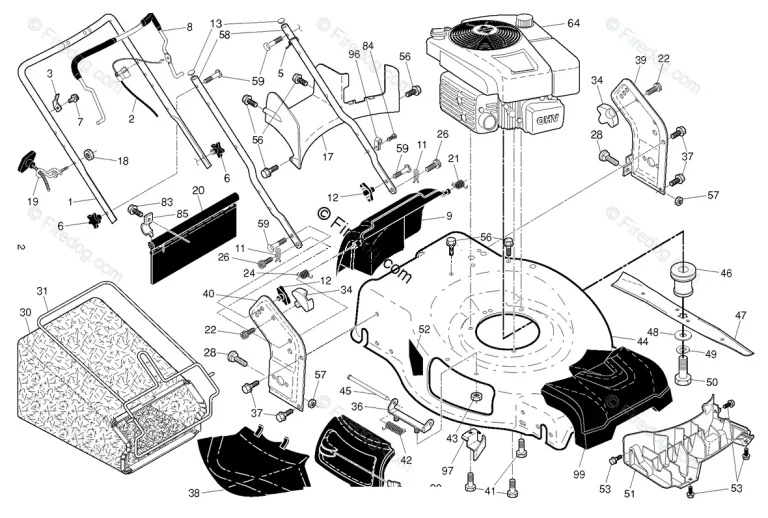
The engine sits on rubber isolator mounts that absorb vibration before it reaches the frame (and your hands). After years of heat, oil, and UV, the rubber cracks and crumbles. With the mounts gone, normal engine vibration transmits straight through — and it feels like something is badly wrong when it’s really just failed isolation.
The “rock the engine” test: engine off and cold, grab the engine shroud firmly and try to rock the engine side-to-side. You should feel slight rubbery give. If the engine clunks against the frame, shifts excessively, or you can see cracked/missing rubber at the mount points, the mounts are shot. Replacement is straightforward on most mowers — unbolt, lift slightly, swap the isolators — but seized mount bolts can turn it into a penetrating-oil-and-patience job.
5. Bent Crankshaft — The Bad-News Cause
If the vibration started immediately after hitting something solid — a stump, a curb, a big rock — and the blade looks fine, the impact may have bent the crankshaft itself. The crankshaft is what the blade bolts to; even a slight bend creates a wobble that no blade balancing can fix.
The wobble test: remove the spark plug, remove the blade, and place a fixed reference (a screwdriver tip held steady) very close to the crankshaft end. Slowly rotate the crankshaft by hand and watch the gap between the shaft and your reference — if the gap visibly opens and closes as it turns, the shaft is bent. A bent crankshaft is pro-repair territory: straightening requires machine-shop equipment, and replacement often costs more than the mower is worth on older machines. Get a quote before deciding.
How to Check Blade Balance at Home
If your blade is undamaged but you suspect imbalance (or you just sharpened it — sharpening removes metal unevenly), do the nail test:
- Remove the blade (engine off, plug wire disconnected, block of wood to hold it).
- Drive a nail horizontally into a wall or post, leaving 2 inches exposed.
- Hang the blade on the nail through its center hole.
- Watch: the heavy side drops. A balanced blade sits level.
- File metal off the heavy end (not the cutting edge — the flat back of the blade) and retest until it hangs level.
It takes five minutes and it’s the difference between a smooth mower and a shaky one after every sharpening. Never grind the cutting edge to balance — you’ll ruin the blade geometry.
When to Stop and Call a Pro
DIY territory: blade replacement, blade-bolt tightening, deck cleaning, blade balancing, engine-mount replacement on most walk-behinds. Pro territory: bent crankshaft (machine-shop straightening or engine teardown), cracked engine block at the mounts, or any vibration that persists after you’ve eliminated causes 1–4. A shop can measure crankshaft runout with a dial indicator in minutes — a definitive answer for a small diagnostic fee.
A well-maintained mower shouldn’t shake your fillings loose — if yours was running smooth and suddenly isn’t, something changed, and the cause is usually in the list above. Regular maintenance prevents most of it; see how to do a lawn mower tune-up yourself for the full seasonal routine. (And if it’s loud as well as shaky, that’s a related but separate issue — see why are lawn mowers so loud.)
Frequently Asked Questions
Why is my lawn mower shaking violently all of a sudden?
You almost certainly hit something. Stop immediately (engine off, plug wire disconnected) and check for a bent or damaged blade and a loose blade bolt — in that order. Sudden-onset violent shaking after an impact is the classic bent-blade or bent-crankshaft signature.
Can an unbalanced mower blade cause vibration?
Yes — it’s the most common cause. At roughly 3,000 RPM, even small nicks, bends, or uneven sharpening throw the blade out of balance enough to shake the whole mower. The nail test (hang the blade on a nail through the center hole; file the heavy side until it sits level) confirms and fixes it.
How do I balance a lawn mower blade?
Hang the blade on a horizontal nail through its center mounting hole. The heavy side will drop — remove metal from the flat back of that end with a file (never grind the cutting edge), then retest until the blade hangs level.
Is it safe to mow with a vibrating mower?
No. Stop and inspect first. Vibration can signal a loose blade bolt or a bent crankshaft — both can fail catastrophically at operating speed. Diagnose the cause (blade, bolt, debris, mounts, crankshaft) before mowing another pass.
Why does my riding mower shake only at full throttle?
Vibration that scales with RPM points to a rotating imbalance — blade, deck belt, or a deck pulley — rather than engine mounts (which usually shake at all speeds). Inspect the blades and spin each deck pulley by hand with the belt off; the bad component will reveal itself.